
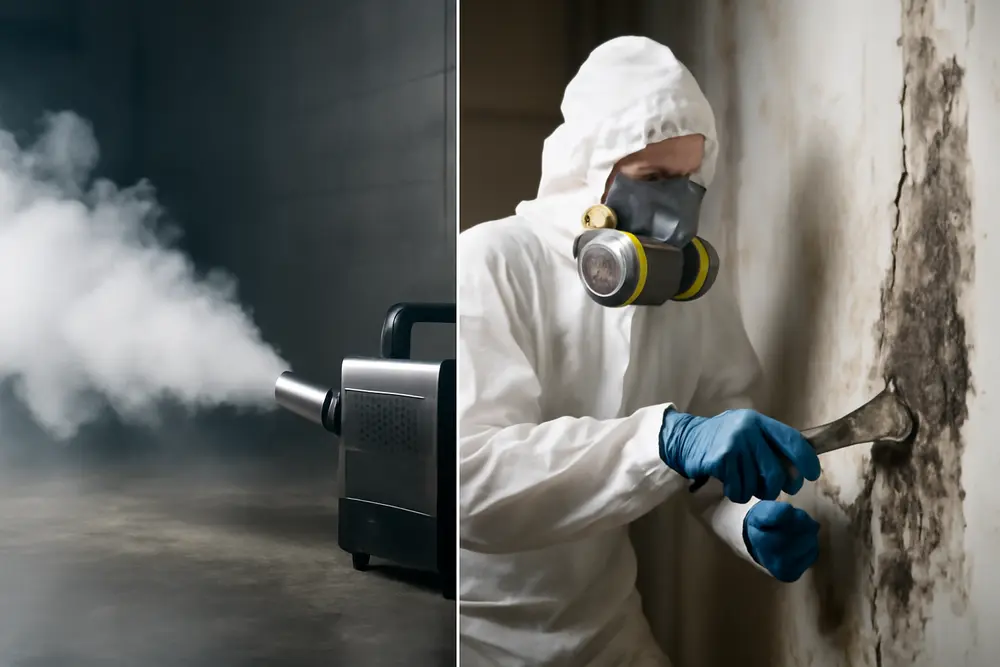
If a magic mist could fix mold, I’d be on a beach sipping something with a tiny umbrella instead of hauling HEPA vacs through crawlspaces. Fogging sounds high-tech and smells like eucalyptus, but it is not a substitute for real remediation. Lasting results come from two things: finding and fixing moisture, then removing the stuff that is actually moldy. Everything else is accessory. Let’s cut through the hype and talk about what actually works, where antimicrobial fogging fits in, and how to spot the red flags before you pay for fancy scented air.
What Antimicrobial Fogging Really Is
Antimicrobial fogging is the practice of atomizing a disinfectant or biocide into tiny droplets and dispersing it into a space. You’ll hear it marketed as wet fogging, dry fogging, ULV mist, or “whole-home treatment.” The goal is simple: get a chemical to touch microorganisms and reduce their counts.
In theory, fogging can help reduce surface microbes on non-porous materials when the product makes direct contact for the right dwell time at the right concentration. In practice, houses are not clean rooms. Droplets collide with dust, settle unevenly, get blocked by furniture, trim, and cavities, and they do not penetrate porous materials like drywall, insulation, carpet pad, or the paper facing on gypsum. Mold grows in and on those porous surfaces, and mist rarely reaches the colonies that are buried in the material. Standards that govern our industry back this up: physical removal of mold contamination is the primary means of remediation, and chemical-only approaches should not replace removal where growth is present.
Source Removal That Actually Sticks
Source removal means taking out what is contaminated and cannot be effectively cleaned, then cleaning and repairing what remains. It is the boring, unsexy work that actually ends mold problems. Here is what source removal looks like on a real job:
First, track down moisture. We use moisture meters, thermal cameras, and sometimes borescopes to find water in wall cavities, subfloors, and attics. Leaks, condensation, roof punctures, clogged weep holes, and misrouted HVAC drains are usual suspects. If you do not fix the wetting mechanism up front, mold comes back no matter how much you spray.
Second, set containment. We isolate work zones with plastic sheeting, create negative pressure with HEPA-filtered air scrubbers, and protect clean areas. Cross-contamination is not a party trick we want to perform in your living room.
Third, remove the bad stuff. That means cutting out moldy drywall and baseboards, pulling wet insulation, tossing saturated carpet pad and certain contents, and bagging everything for proper disposal. For structural wood with surface growth, we clean using HEPA vacuuming, controlled abrasion like sanding or blasting, and damp wiping with surfactants. The goal is to physically remove the colonies and fragments, not just perfume them.
Fourth, dry the structure to target moisture content. We document moisture readings and run dehumidifiers and targeted air movement until the building materials are back in an acceptable range. Skipping this is how you buy yourself a second mold job.
Fifth, verify. We do visual inspections and cleanliness checks, and when appropriate an independent third party performs post-remediation verification. Clearance is not a vibe, it is documentation.
Standards And Guidance That Matter
There are written standards for this work. The ANSI/IICRC S520 standard for professional mold remediation makes it clear that correcting the moisture source and physically removing mold contamination are the backbone of the process. Attempts to “kill” or encapsulate mold without removal are not adequate when growth is present on porous materials. Widely cited public guidance from agencies and professional bodies echoes this: fix water problems, take out moldy materials that cannot be cleaned, and use engineering controls to keep occupants and workers safe. Fogging and coatings may have defined, narrow uses, but they are not stand-ins for removal and drying.
When Antimicrobial Fogging Helps
I am not here to ban foggers. I own them and use them when they actually serve the plan. Antimicrobial fogging can be helpful as a supplemental step in very specific scenarios:
After demolition and detailed cleaning, a correctly selected and labeled disinfectant may be misted onto non-porous surfaces to reduce residual microbes. Think of it as the rinse at the end of the car wash, not the whole wash.
For odor control after category 3 water losses or microbial cleanup, certain products can help knock down smells once the source has been removed and the area is dried and cleaned. Odor control without source removal is scented denial.
In limited, engineered conditions to reduce airborne particulates during work. We prefer source containment and HEPA filtration as the primary controls, but a mist can supplement particle control in a pinch.
Any use has to follow the product label and applicable laws. That means correct dilution, dwell time, compatible surfaces, adequate ventilation, and trained applicators. You do not fog people or pets. You do not fog and leave wet walls behind. You never fog instead of fixing the reason the mold grew.
Why Fogging Alone Often Fails
Fogging is appealing because it is fast and feels high-tech. Here is why it often fails when it is sold as the solution:
It does not resolve moisture. Mold is a moisture problem first. If you still have a leak, condensation, high humidity, or capillary wicking, mold returns. No mist fixes physics.
It cannot reach hidden growth in porous materials and cavities. Mold hyphae grow into paper facings, wood fibers, and inside wall voids. Fog droplets cannot reliably reach or stay on those surfaces at an effective concentration.
Dwell time and soil load ruin the promise. Disinfectants require clean surfaces and specific contact times to work as advertised. Real homes have dust, oils, and irregular surfaces that reduce activity, and droplets dry or run off before the clock runs out.
Residues and re-wetting can backfire. Some products leave sticky films that grab dust and look terrible on finishes. Overly wet fogging can add moisture in already humid spaces and give mold another reason to move back in.
It encourages false confidence. Contractors who fog and go often skip containment, skip removal, skip drying, and skip verification. You are left with a bill, a scent, and the same problem behind the paint.
Fogging Vs Source Removal
If you like pictures more than speeches, here is the comparison that matters.
| Approach | What It Does | Where It Works | Where It Fails |
|---|---|---|---|
| Antimicrobial Fogging | Applies disinfectant mist to exposed surfaces and air | Supplement after cleaning on non-porous surfaces, limited odor control | Porous materials, hidden cavities, moisture problems, replacing removal |
| Source Removal | Fixes moisture, removes contaminated materials, cleans and dries | Small and large projects where growth is present | Only fails when moisture is ignored or scope is incomplete |
Red Flags You Should Avoid
Here are the greatest hits that make me want to put my coffee down and pick up a soapbox:
- One-treatment cures-all promises. Anyone claiming a single fog kills all mold forever is selling you a fairy tale.
- No moisture diagnostics. If the proposal does not mention finding and correcting water sources, it is incomplete.
- No removal of porous materials. Moldy drywall, insulation, carpet pad, or cabinetry that is obviously contaminated should not be left in place.
- Credentials you cannot verify. Look for training like IICRC AMRT and WRT and a track record you can check.
- No containment or air filtration. If they are not talking about barriers and HEPA filtration, they are planning to share your problem with the rest of your home.
- In-house testing to grade their own homework. Post-remediation verification should be done by an independent party, not the company that did the work.
- Coatings sold as shields. Encapsulants can lock down dust after cleaning, but they do not hide active mold or fix leaks.
How To Hire The Right Remediator
You do not need a PhD in spores to hire well. You just need a plan and the right questions. Start with standards. Ask if they follow ANSI/IICRC S520 and how they will tailor it to your home. Listen for clear steps: moisture investigation, containment, source removal, detailed cleaning, controlled drying, and third-party verification when appropriate.
Ask about diagnostics. Good pros carry moisture meters, thermal cameras, and have a method to track hidden water. If their only tool is a brochure, keep shopping.
Get the scope in writing. It should spell out the areas of work, materials to be removed, how they will handle contents, what kind of containment and filtration they will use, and what the clearance criteria are. If fogging is in the scope, it should show up as an adjunct to cleaning on non-porous materials, not job centerpiece.
Check training and insurance. IICRC AMRT-certified technicians, documented safety training, and proper general liability and pollution liability coverage are table stakes. Ask for references from similar jobs.
Separate inspection from remediation where practical. An independent assessor or hygienist can confirm the scope and provide post-remediation verification. It keeps everyone honest and focused on measurable results.
Clarify documentation. You should receive photo logs, moisture maps, and drying records. If a contractor is allergic to documentation, that is not a good sign.
What We Actually Do On Real Jobs
Here is a real-world style scenario. An attic leak from a punctured roof flashing soaked the insulation and stained the truss tails. The homeowner got two quotes for fog-only treatments that promised to “neutralize all mold” in a day. We took a different route.
We traced the stain patterns with a thermal camera and moisture meter to confirm the path of intrusion and found wet decking around the penetration. A roofer fixed the flashing and we set containment at the attic access with a zipper, laid protective sheeting, and ran a HEPA air scrubber to maintain negative pressure.
We removed the wet blown-in insulation and bagged it. Surface growth on the truss faces was cleaned by HEPA vacuuming, then controlled abrasion to remove the top layer of growth and staining. We followed with a surfactant wipe-down and returned with a borescope to check hard-to-see connections. We set dehumidification to hit target wood moisture content and held it there until readings stabilized. After a visual and white-glove style cleanliness check, a third party performed verification. Only then did we consider a light mist of a label-appropriate product on the sheathing for odor control. Months later, with the roof fixed and the attic dry, there was no return appearance. No fog-first shortcut would have fixed the flashing or removed the contaminated insulation.
What About Coatings Or Encapsulants?
Coatings can be helpful as a finishing step on cleaned, dry, accessible structural surfaces. They lock down microscopic dust and improve light reflectivity in basements, crawlspaces, and attics. They are not paint-it-and-forget-it solutions, and they should never be used to hide unremoved growth. If a contractor waves a bucket of “mold paint” and tries to skip removal or drying, that is just another shortcut in a different can.
Do You Need To Fog Your HVAC?
Treating HVAC systems is a specialty all its own. If the air handler or ducts are contaminated due to water intrusion or construction dust, the right response is inspection by a qualified HVAC cleaning firm. That can include source removal inside the unit, coil cleaning, drain pan correction, and duct cleaning following NADCA standards. Randomly fogging a running system can distribute chemicals and moisture through the home and still miss the actual buildup. Fix the reason the system got contaminated, then clean it correctly.
How Long Should Proper Remediation Take?
There is no universal clock, because the scope depends on how much material is affected and how deep the moisture problem runs. A small bathroom wall with mold behind a leaky valve might be a couple of days including drying. A basement with chronic seepage and widespread porous material removal can take a week or more, plus curing time for repairs. Any plan that promises your entire multi-room issue is “fixed today” with a single fog is not delivering the steps required for durable results.
Cost And Value Reality Check
Source removal costs more than a spray-and-pray for the same reason a real roof costs more than a tarp. You are paying for diagnostics, skilled labor, containment, specialized filtration, disposal, and drying equipment, not just a gallon of chemical. The flip side is you are not paying for the same problem twice. Proper moisture correction and removal reduce the chance of recurrence and the need for re-treatment. Cheap now, expensive later is not the savings anyone wants.
FAQ
Does Killing Mold Spores End The Problem?
No. Dead mold fragments and byproducts can still cause irritation, and the material they live on is still contaminated. The job is to remove growth and debris, not just declare it lifeless. Fix moisture and remove affected materials to end the cycle.
Can I Just Bleach The Mold?
Bleach is not a mold remediation plan. It can discolor surfaces and is not great on porous materials. It also adds water to an already wet problem. If you are cleaning a small non-porous area yourself, use a detergent and water, dry it quickly, and address the moisture. For anything more than a few square feet or anything porous, call a pro.
Is Botanical Fogging Safer Or Better?
“Botanical” describes ingredients, not results. Whether synthetic or plant-derived, every product has a label with limits. Neither type replaces source removal. Used correctly as a supplement, some botanical products can be useful. Used as a one-step cure, both disappoint.
Do I Always Need Third-Party Testing?
Not always, but it is wise on larger or sensitive projects, in real estate transactions, or when occupants have special concerns. Independent verification sets objective criteria for success and avoids conflicts of interest.
What Should I Expect In The Proposal?
Look for moisture source correction, a clear demolition and cleaning plan, containment and HEPA filtration details, drying targets, disposal methods, and verification steps. If you only see “fog whole house,” that is not a real scope.
The Bottom Line For Lasting Results
If you want mold gone and to stay gone, chase moisture like a bloodhound and remove the material that is colonized. Use antimicrobial fogging only as a supporting actor after the heavy lifting is complete, and only where it makes technical sense. Hire pros who follow established standards, document their work, and welcome verification. The fastest way to waste money in this business is to buy theatrics when what you need is a careful, methodical plan that treats causes and removes sources. That is how you stop paying for the same square foot twice.