
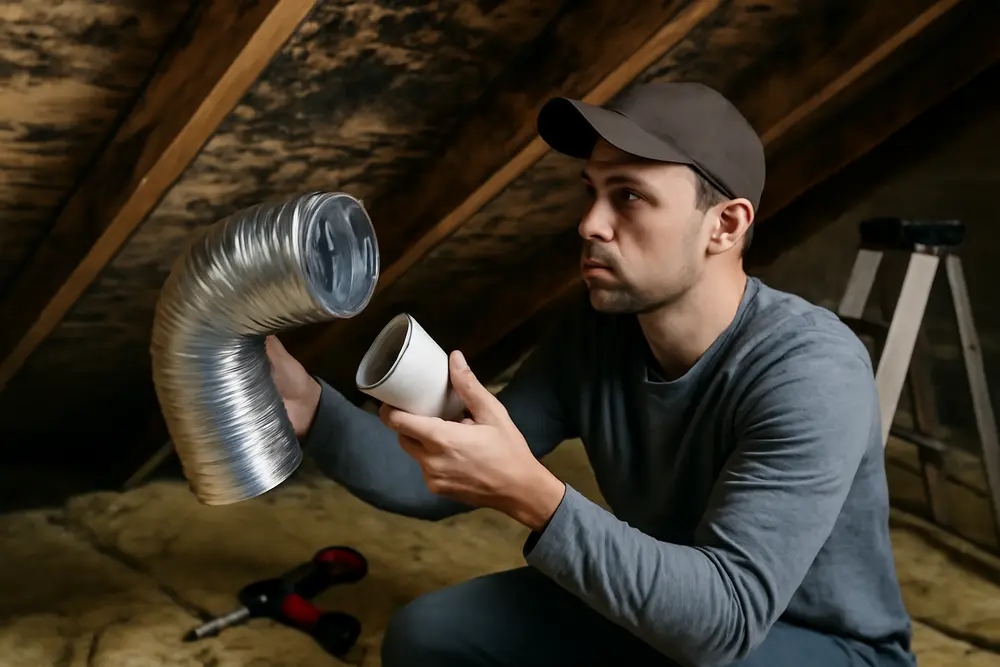
If your bathroom fan duct is sweating like it just ran a marathon, your attic is probably the finish line. Bath fan duct condensation is the classic silent troublemaker that turns clean lumber into spotty science projects. When a fan dumps moist air into an uninsulated pipe or, worse, straight into the attic, that steam cools, condenses, drips, and feeds mold. We see this all the time. The fix is not just a new fan or a spray of bleach. You need a solid inspection, safe cleanup if mold is present, and a proper reroute with insulation, air sealing, and a real outdoor termination. Let’s stop attic mold from exhaust ducts before it trashes your roof deck and insulation.
Why This Problem Hides In Plain Sight
Bathroom exhaust fans move the wettest air in your home. When that air rides through a cold, uninsulated duct, it sheds water on the first chilly surface it touches. That can be the inside of the pipe, the fan housing, or the nearest rafter. Now add gravity. The water will drip into insulation, stain drywall, and spark mold on roof sheathing. If the duct ends in the attic or under a soffit where the moist air can loop right back in, the whole attic turns into a mildew spa.
Our own attic water damage guide calls this out because it’s so common in real homes. We routinely find bath fans or dryer vents dumping moisture into attics where it saturates insulation, rots wood, and sets the stage for mold growth. Early symptoms are faint musty odors, darkened rafters, and insulation that looks tired and clumpy instead of fluffy and dry. Left alone, you can expect insulation to lose R-value, roof framing to weaken, and mold to spread across sheathing. None of that ends with a happy contractor bill.
Early Signs You Can Spot
You don’t need a lab coat for this. Pop the attic hatch and bring a bright flashlight. If the duct is short and shiny but not wrapped, if it snakes straight into nothingness, or if it stops right under the roof deck or soffit, you’ve got a problem brewing. Look for water rings on the drywall around the fan box, rusty fan screws, damp or matted insulation, and gray or black spotting on roof sheathing or rafters near the duct path. If your fan grille drips in winter or you notice foggy mirrors long after a shower even with the fan running, that’s another clue the system is underperforming.
How To Inspect Without Making A Mess
Start in the bathroom. Remove the fan grille and eyeball the housing. If it looks dusty enough to knit a sweater, clean it. Confirm the fan actually moves air by holding a tissue to the grille. It should stick. If it flutters or falls, the duct may be clogged, crushed, or disconnected.
Head to the attic with a strong light, gloves, and a mask. Follow the duct from the fan housing to its termination. The run should be short, straight, and sealed. Many problem installs end right under the roof deck or vanish into a soffit cavity. That’s not venting outdoors. If your duct hits a roof or wall cap, great, but confirm there are no gaps at the connections, no crushed sections, and that the duct is insulated in any unconditioned space. If you see water beads inside clear flex duct or dark streaks on rafters near the run, you’re looking at bath fan duct condensation doing what it does best.
Check the exterior too. Watch the cap while the fan runs. The damper should pop open and you should feel air moving. If the flap sticks or the cap is clogged with lint, leaves, or a bird nest, that backpressure can push moisture back into the attic. While you’re up there, take the temperature and humidity in the attic if you have a hygrometer. Target under 50 percent relative humidity for a healthy space.
Mold Present Now What?
First, stop feeding the mold. That means fixing the duct routing and condensation problems while you handle cleanup. Do not just paint over the spots and call it done. If the source stays, the mold comes back like a bad sequel.
Safety matters. Wear gloves, eye protection, and an N95 or better yet a P100 respirator. Lay down plastic to protect the access path. Gently remove and bag any insulation that’s wet or mold-stained. Double-bag it before it leaves the attic. Use a HEPA vacuum on dusty surfaces. For small areas and light growth on framing or sheathing, clean with an EPA-registered mold cleaner or a detergent solution. Bleach is only for non-porous surfaces, and if you use it, ventilate well and never mix it with other cleaners. The goal is to remove the growth, not just bleach it pale.
Work size matters too. In Texas, you can handle visible mold smaller than 25 contiguous square feet without a mold license. Bigger areas, heavy contamination, or structural damage should go to a licensed mold remediator. If the sheathing is soft, the growth is widespread, or you’re seeing recurring moisture, bring in pros who can set containment, run negative air, and restore framing safely.
Drying is not optional. Before you replace insulation or close anything up, dry the wood to typical interior moisture content. Run the corrected bath fan, add temporary ventilation, or use professional drying equipment if needed. Once dry, some projects benefit from a stain-blocking primer on previously affected sheathing after cleaning. Skip that if moisture is still present. Paint is not a magic sponge.
Fix The Duct The Right Way
Here’s the punch list our techs follow when we correct bath fan installations that caused attic mold from exhaust ducts. Do these and the problem stays gone.
Vent outdoors only. Building codes and common sense both say bathroom exhaust must discharge to the exterior, not into attics, crawlspaces, or soffit cavities. Terminate through a roof cap or a wall cap with a damper and bird screen. Avoid soffit terminations. They can pull moist air right back into the attic with intake ventilation.
Short and straight wins. Keep the duct run as short as possible with few bends. Each sharp turn slashes airflow and raises the odds of condensation. If you must change direction, use long-sweep elbows with rigid duct. Measure actual airflow after the fix. That fan label rating is fantasy without good ducting.
Slope the run toward the exterior cap. A tiny downhill pitch lets any condensate drain out instead of pooling and dripping back into your ceiling. If your climate is cold or you have long runs, this simple slope is worth its weight in saved drywall.
Go rigid when you can. Rigid metal duct moves air better and resists sagging and water pockets. If you must use flex, keep it stretched tight without sags and secure it with band clamps. Either way, seal every joint with mastic or UL 181 foil tape. Regular duct tape dries out and fails. Yes, the irony is painful.
Insulate the duct in any unconditioned space. Uninsulated pipe in a cold attic is a condensation machine. Use an insulated flex duct with at least R-8 or wrap rigid metal with equivalent insulation. Pay extra attention near the cap where air is coldest. A roof cap with a built-in insulation collar is a nice upgrade.
Use backdraft dampers. You want a damper at the fan housing and at the exterior cap. This tag-team keeps cold, damp air from sneaking in when the fan is off. Check that both move freely and fully close.
Air seal the fan box and ceiling. Even a perfectly routed duct can lose the battle if humid room air leaks around the fan housing into the attic all day. Seal the housing-to-drywall gap with caulk or foam, and seal any wire penetrations. While you’re at it, air seal other attic bypasses like can lights and chase openings. Your insulation will actually start doing its job again.
Pick the right fan. Undersized or weak fans push moisture problems along. As a rule of thumb, bathrooms need about 1 CFM per square foot of floor area with an 8-foot ceiling. Go higher for big rooms, jetted tubs, or enclosed showers. Look for quiet units that actually move air through real ductwork, not just on a test bench.
Know The Code And The Stakes
The International Residential Code and International Mechanical Code require bathroom exhaust to discharge outdoors. That means not into the attic, not into a crawlspace, and not into a soffit cavity. If your current setup breaks this rule, you’re not just risking mold. You’re likely out of compliance with building standards. Correcting it is not optional if you care about your roof, your insulation, and yes, your indoor air quality.
If you’re in Texas and you discover more than 25 contiguous square feet of visible mold, that tips into licensed mold remediation territory. When in doubt, reach out. Our team handles both the moisture source and the cleanup so you don’t fix one and leave the other.
Smart Habits That Keep It Fixed
Run the fan during showers and for 20 to 30 minutes afterward. A countdown timer switch or a humidity-sensing control takes the guesswork out and stops teenagers from tapping the switch and sprinting away. Keep the grille clean. Dust chokes airflow and makes even a good fan act like a whisper.
Check the exterior cap twice a year. Make sure the flap swings freely and the screen is clear. Birds love warm ducts. You will not love what they leave behind. Peek in the attic at least once a season to confirm you’re not collecting condensation or new stains. If your attic routinely runs over 50 percent RH, improve attic ventilation and make sure your insulation levels are correct and continuous. Leaky recessed lights, open chases, and unsealed top plates can sabotage even perfect ductwork by loading the attic with household humidity.
Why This Happens More Than You Think
Homes are a patchwork of improvements over decades. Someone upgrades a fan but keeps the old floppy duct. Someone else adds insulation without fixing the air leaks first. Another person vents through a soffit because it’s faster on a hot roof day. All of that points moisture down the wrong path. Our field crew constantly sees attic mold from exhaust ducts that looked fine from the bathroom ceiling. The real story is always in the attic. If you never look, you’ll never know until the stains show up in the room below.
A Simple Repair Plan That Works
Here’s how we fix these installs for good. We reroute the duct to a proper exterior termination. We switch to rigid metal with tight joints and a gentle slope to the outside. We insulate the entire run in the attic. We install and verify backdraft dampers at the fan and at the cap. We air seal the fan housing, ceiling gap, and nearby penetrations. Then we confirm airflow with the grille in place and the door closed to simulate real use. Finally, we address any mold cleanup and drying, replace damaged insulation, and leave access photos so you know exactly what changed. It’s not glamorous, but it’s how you stop bath fan duct condensation from wrecking your attic again.
DIY Or Call A Pro?
If you’re comfortable on roofs, have access to the attic, and can seal and insulate ducts properly, a straightforward reroute is within reach. The big caveats are safety and quality. Roof cuts and cap installs demand careful flashing. Attic work in summer can be brutal. And the best ductwork in the world still fails if the joints are loose or the slope is wrong. If mold is present or the termination needs a new roof or wall cap, bring in a restoration-contractor pairing instead of juggling three trades and a headache.
Fast Attic Walkthrough Checklist
Use this quick-hit list to smoke out problems before they spread.
- Does the bath fan duct terminate outdoors through a proper cap?
- Is the run short, mostly straight, and gently sloped to the exterior?
- Are all joints sealed with mastic or UL 181 foil tape, not cloth tape?
- Is the duct insulated in unconditioned spaces, ideally to R-8?
- Do both the fan damper and exterior flap move freely?
- Any dark staining, damp insulation, or rusty fasteners near the run?
- Does the fan actually hold a tissue to the grille when on?
Tools And Materials We Trust
You don’t need a cargo van of gadgets. A good LED flashlight, a hygrometer, UL 181 foil tape, mastic, band clamps, rigid metal duct sections or quality insulated flex, a proper roof or wall cap with damper, and protective gear will cover most projects. Add a countdown timer or humidity sensor switch while you’re at it. If you want to get fancy, an anemometer helps confirm airflow so you know the fix actually moved the needle.
What About Venting Through A Soffit?
We get this one a lot. In theory, a soffit cap could work. In real houses, soffits often pull outside air into the attic through intake vents. If your bath exhaust ends near or inside that intake path, you’re feeding your attic the very moisture you tried to remove. That is how we got here. Roof or wall termination beats soffit termination nine times out of ten, and the tenth time still gives us heartburn.
How We Handle The Mold Side
After we stop the moisture source, we remove contaminated insulation carefully, HEPA vacuum dust, and clean affected framing with an EPA-registered cleaner. If staining remains but wood is sound and dry, we may apply a stain-blocking primer depending on the project needs. Severely rotted or delaminated sheathing calls for carpentry repair, not cosmetics. We monitor moisture content until it stabilizes at normal levels before closing up or reinsulating. That’s the difference between a “looks better” fix and a real restoration.
Ready For A Sanity Check?
If you’re in the Austin area and you’re not sure where your bath fan duct goes, here’s your nudge to check. We can inspect, document, remediate, and fix the ducting so the problem stays fixed. Start with a quick attic look. If you find a duct that ends in the dark, soggy insulation, or spotting on the roof deck, reach out. Your roof and your lungs will thank you later. If you want some background reading first, our attic moisture guides explain how a little stray humidity can trash a lot of expensive wood and insulation.