
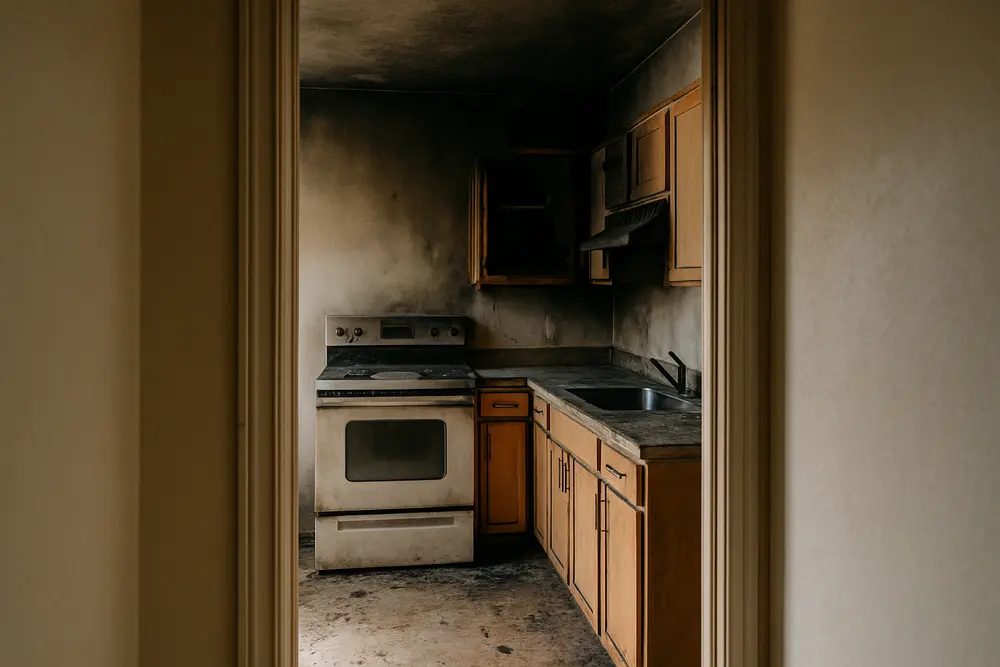
Your kitchen fire is out, the blackened pan is gone, and the bedroom down the hall never felt hot. Yet your bedroom smells smoky, and a faint gray line has appeared above the doorway. You may be asking, how far does smoke travel after a fire? There’s no fixed answer because heated air and building airflow can carry contamination well beyond the last burned surface, causing smoke damage in rooms that never got hot.
How Far Does Smoke Travel After a Fire?
Smoke may remain near the source or move through much of your building, depending on how long the fire burned and which airflow paths were available. A running air handler can spread smoke farther than an open hallway, while a closed bedroom door may limit deposits in a room only a few feet from the fire.
The edge of the burned area shows you where flames stopped, not necessarily where smoke stopped. Flames need enough heat and suitable fuel to continue moving, but smoke rides with air and can pass through a doorway or duct without igniting anything along the way. If you treat the flame boundary as the cleanup boundary, you can easily miss the real affected area.
Why Smoke Leaves the Burned Room
Heated Smoke Rises and Spreads
A fire produces a plume of heated gases that is less dense than the surrounding air, so the plume rises until it reaches the ceiling and then spreads outward. When you inspect the area, you’ll often find the first visible deposits on ceilings and cabinet tops.
The NIST Fire Dynamics Simulator research treats smoke movement as a fluid-flow problem involving heat and ventilation, which is why proximity alone doesn’t tell you where contamination landed. Smoke from a wastebasket fire can reach the top of a doorway before flames ever leave the immediate fuel.
Pressure Picks the Route
Heating causes gases in the fire area to expand, creating pressure that helps push smoke through available openings, though ventilation conditions can change that pressure pattern. Once smoke cools, your building’s normal airflow may have more influence than the smoke’s original upward movement.
You may find more residue in a distant room connected to a return-air pathway than in a closer room behind a closed door. That can feel backward when you inspect the building afterward, but smoke follows flow paths rather than spreading in tidy circles around the fire.
Moving Smoke Pulls in Replacement Air
Air leaving the fire area has to be replaced, so cooler air can enter low while hot smoke exits high, creating a continuing flow that feeds combustion and transports contamination. You may notice this effect most clearly around stairwells because they connect lower and upper levels through a large vertical opening.
Firefighting operations can change the final pattern you see after the incident because ventilation alters pressure and smoke movement, while water streams may carry wet soot onto adjoining surfaces. As a result, the residue left behind isn’t a perfect record of where smoke traveled earlier.
Open Doors Become Smoke Highways
If a doorway remains open during a fire, it can support two-way flow between rooms, with hot smoke moving through the upper part while cooler replacement air enters near the floor. The room across the hall doesn’t need to burn for its upper surfaces to collect residue.
When a door stays closed, it can make a major difference in heat and smoke exposure. Research behind the Close Before You Doze campaign shows how door position affects heat and smoke exposure during residential fires, which is strong life-safety evidence, but you still shouldn’t assume everything behind a closed door will be residue-free.
Because ordinary interior doors aren’t airtight, smoke may pass under them or through gaps around the frame, and shared ductwork or wall penetrations can provide another route. You can’t settle the question by looking only at a clean door face.
HVAC Systems Can Extend the Path
A running HVAC system can pull contaminated air into a return and redistribute it through supply registers, so the nearest return matters more than you may realize. If a return sits outside the fire room, smoke entering the hallway may be drawn into the system before you see obvious staining nearby.
Even when your HVAC system is idle, pressure differences can move air through ducts or mechanical chases, but that doesn’t mean every fire calls for full duct cleaning. In my opinion, selling you automatic whole-system cleaning without first checking system operation and actual contamination is usually overkill.
A useful HVAC inspection considers whether your equipment ran during or shortly after the fire, while filters and accessible duct surfaces can provide additional evidence. Dark residue at a register matters, but one dirty vent doesn’t prove that every branch is affected.
During your inspection, hidden areas such as filter housings may reveal contamination that isn’t visible in the rooms, and moisture from suppression may combine with deposited residue on coils and metal components. Your cleaning scope should follow that evidence, not a blanket assumption that all ducts are either clean or ruined.
Clean-Looking Rooms May Still Be Affected
You shouldn’t expect all smoke contamination to look or behave the same way. The EPA’s combustion product overview explains that burning can produce particles and gases, with the mixture changing according to the fuel and burn conditions; some particles are small enough to create a thin film without the dramatic black soot you might expect.
When you inspect an adjacent room, look high before declaring it clean because deposits may collect near upper edges and vents. Odor gives you another clue, though it doesn’t prove how much residue is present or whether that residue is corrosive, so you need to assess the room using its airflow history and surface conditions together.
Porous Materials Hold What Air Delivers
Even after the air clears, porous materials can retain part of the smoke transported between your rooms. Carpet pad can hold odor-producing compounds below a clean-looking carpet face, while upholstery may collect particles throughout its textured surface.
Before cleaning, your fabric chair may smell fine when the room is cool, only for the odor to become obvious again after the room warms in the afternoon. That change doesn’t mean new smoke entered; compounds retained in the material may become more noticeable as temperature or humidity changes.
Porous items such as books and acoustic ceiling tile can be difficult for you to evaluate because contamination reaches pores and edges, while smooth surfaces are generally easier to inspect even though residue may remain in joints or textured coatings. Spraying fragrance into the room doesn’t remove those deposits, and it can make your diagnosis harder by covering the odor temporarily.
Residue Can Keep Damaging Materials
The material that burned determines much of the residue chemistry you’re dealing with, and plastics or synthetic furnishings can leave deposits with different properties than a small wood fire. Depending on that composition and the exposed surface, leaving residue in place may increase the chance of staining or corrosion.
Your electronics deserve prompt attention because fine deposits can reach cooling openings and electrical contacts. You may see no black coating on the outside of a computer even though residue has entered with airflow through its fan, and odor alone can’t tell you whether the deposit is conductive, so guessing from the smell is poor equipment triage.
If you deodorize the room before cleaning the source, you’re covering the problem rather than restoring the affected materials. Fogging a fragrance over soot is cosmetic work dressed up as restoration, while ozone is a bad casual fix because the EPA warns about ozone generators, including health concerns and chemical reactions that can create other pollutants.
Inspection Should Follow the Smoke Path
A useful inspection starts with your fire timeline and the positions of nearby doors, then considers whether the HVAC system operated and where the returns were located. Those facts help explain why one room smells stronger than another and where you need a closer surface examination.
As you inspect the building, watch for discoloration near ceiling edges and residue around supply registers. Window coverings may hold odor even when painted walls look normal, and closets or cabinet interiors deserve attention when gaps or pressure pathways could have carried smoke inside.
You can’t define the entire contamination boundary with one wipe from one wall because different surfaces collect residue at different rates, and cleaning done before the inspection may erase obvious clues. Professional judgment should connect the physical evidence with how air moved during your fire.
When Austin Hi-Tech Restoration handles fire damage restoration, we look beyond the charred room to establish where smoke likely traveled and what materials retained it. If you find odor or residue outside the fire area, use our contact page to request an evaluation before repainting or deodorizing covers evidence that still needs attention.
Common Questions About Smoke Travel
Can Smoke Get Inside Closed Cabinets?
Smoke can get inside your closed cabinets, though the amount varies because cabinet doors have seams and pressure-driven air can carry fine particles through small gaps. You should inspect items near the cabinet opening more closely before assuming everything inside is clean or discarding it.
Why Does Smoke Odor Return on Humid Days?
Porous materials in your building may retain odor-producing compounds after surface cleaning, and changes in humidity can make those odors easier for you to notice. A returning smell points to a retained source, but it doesn’t measure the residue level by itself.
Can You Paint Over Smoke Residue?
If you paint before proper cleaning, you can trap odor, create adhesion problems, and allow heavy residue to bleed through an ordinary coating. The surface needs an appropriate cleaning and preparation plan based on the deposit and material.
Should Every Room Be Cleaned After a Fire?
You shouldn’t clean every room automatically because that can waste money and disturb unaffected contents; instead, your scope should be based on the evidence found in each area and the likely smoke pathways.
References
- FDS-SMV (pages.nist.gov)
- Home (closeyourdoor.org)
- What are combustion products? (epa.gov)
- Ozone Generators that are Sold as Air Cleaners (epa.gov)