
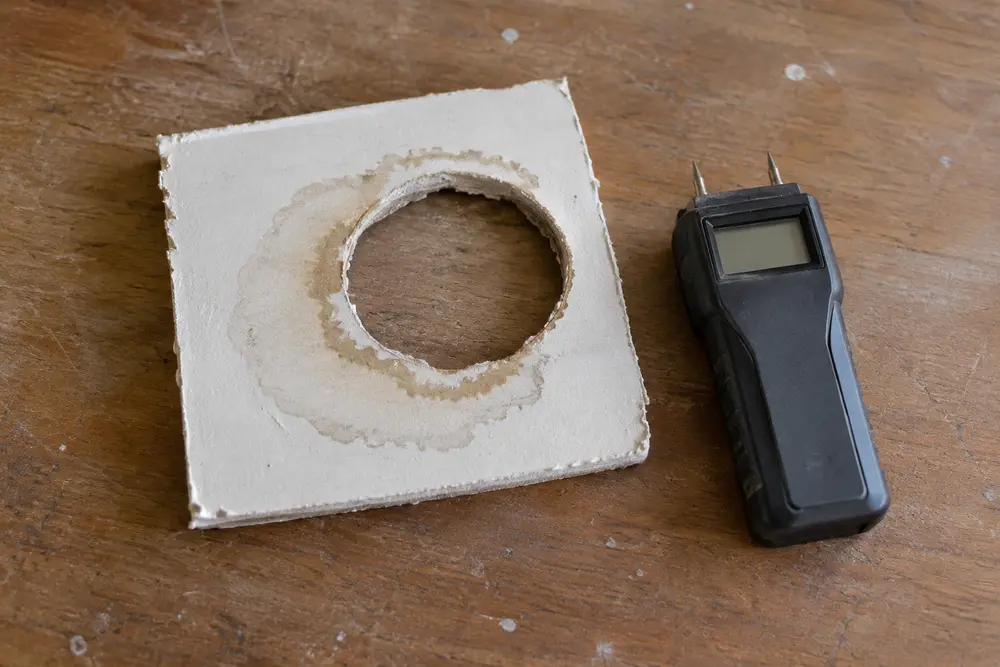
Most people size up a ceiling stain by its color, assuming a dark brown mark is old while a pale yellow one is recent. Some even take several rings as proof of several leaks, but that approach falls short because the mark records how water interacted with the ceiling and offers no reliable date for when the water arrived.
If you’re wondering how to tell if a water stain is old, you generally can’t determine its age from appearance alone because a pale stain can contain current moisture, while a dark stain may remain after the material dries. If your question is “is a water stain still wet,” touch won’t settle that either because paint can feel dry while hidden moisture remains behind drywall.
How Old Is the Stain?
The age of visible discoloration and the date a leak began are separate questions, and neither one tells you whether the source has been repaired.
A stain that appeared years ago can become wet again when a roof leak returns during heavy rain, and the old discoloration may hide the new wet boundary, leaving the ceiling looking unchanged even as moisture spreads behind it.
The reverse can happen too: a recent plumbing drip may leave a sharp brown mark after the exposed surface has already dried, so you still need to investigate the source and adjoining materials before calling the problem finished.
An Old Mark Can Get Wet Again
A recurring water stain is easy to dismiss because you’ve seen it before, and that familiarity is exactly what makes it risky. Moisture can re-enter when flashing fails or condensation develops around an HVAC component, and the EPA’s building moisture guidance explains how water can move through an assembly by capillary movement, which means the visible spot may be some distance from the entry point.
Why Color Lies
Darkness Comes From More Than Time
Darkness can come from dirt inside a cavity, rust from a fastener, or tannins carried by water passing across wood, but none of those substances arrives with a timestamp.
A small amount of dirty water can produce a darker stain than a larger amount of cleaner water, while paint chemistry affects how discoloration appears through the finish.
Light Color Doesn’t Prove Dryness
A faint mark can sit over damp insulation or wet framing because the surface coating may slow evaporation toward the room, leaving the face dry while moisture remains deeper in the assembly.
This is why comparing colors across two different stains gets you nowhere: different materials and travel paths can create different marks even when the wetting happened at roughly the same time.
Rings Are Residue, Not a Calendar
A water ring on a ceiling forms as moving or evaporating liquid deposits material near an edge. Research into ring stains caused by capillary flow helps explain why residue concentrates along a perimeter, but it doesn’t turn each ring into evidence of a separate leak event.
Repeated rings may reflect repeated wetting, though they can also develop as one wet area changes shape during evaporation, so counting rings and assigning dates is guesswork dressed up as diagnosis.
Claims Versus Useful Evidence
Visual clues have value because they show where to start looking, but problems begin when those clues get treated as proof.
| Common Claim | What the Evidence Supports |
|---|---|
| A dark stain must be old | Darkness can reflect concentrated residue or rust. |
| A light stain must be dry | Color intensity doesn’t measure moisture behind the finish. |
| Each ring marks one leak | Liquid movement and evaporation can create several boundaries. |
| A dry surface proves the leak stopped | Concealed layers may remain wet, and the source may operate intermittently. |
| One meter reading dates the leak | The reading documents material condition at that location and time. |
Odor doesn’t provide a reliable clock either. A musty smell deserves investigation, but its strength can’t tell you the day water entered.
What Moisture Mapping Can Show
Moisture mapping is a documented survey of affected materials that draws on readings from multiple locations across the area.
Start With the Likely Source
The inspection begins by checking where water could enter. A ceiling mark below a bathroom might involve a supply connection or drain, while a mark along an exterior wall could involve roofing or a window opening; the stain location narrows the search, but it doesn’t prove the source.
Compare Similar Materials
A moisture meter for water damage should be suited to the material being tested. Readings from the suspected area are compared with unaffected material of the same type when possible because there isn’t one universal number that declares every wall or floor dry.
The readings can outline where elevated moisture appears to stop, although adjacent areas still matter because water may follow framing or seams before it becomes visible.
Measure the Trend
Repeat measurements can show readings falling during drying, while stable or rising readings may point to continuing water entry, although even a clear trend doesn’t reveal the exact date when the original leak began. Professional water-damage restoration standards emphasize systematic evaluation and documentation, which is a long way from judging a brown ring by eye.
Thermal Images Need Confirmation
An infrared camera records surface-temperature differences, leaving the presence of water inside a wall to be established through other testing. Evaporation may cool a damp area, while missing insulation can produce a similar pattern.
The Department of Energy’s thermography guidance explains that environmental conditions affect interpretation, so a thermal anomaly can identify a place worth testing, but a direct moisture reading or further inspection must confirm what caused it.
Damage Shows Condition, Not Age
Material condition can tell you that water has caused meaningful damage: soft drywall and sagging gypsum indicate lost strength, while swollen trim or delaminated flooring can show that replacement deserves consideration.
Corrosion confirms that metal has reacted with moisture, but corrosion speed depends on the material and exposure conditions, so you can’t look at a rusty fastener and assign a reliable leak date.
Visible microbial growth is another condition that needs proper evaluation, but its color doesn’t date the moisture. The EPA’s homeowner moisture guidance recommends addressing the moisture source and checking for hidden water damage, including concealed areas inside walls.
Before-and-after appearance can mislead you too because a wall may look better after the surface dries while the insulation remains damp. Material observations help define what needs attention, but they don’t function as a calendar.
When the Stain Needs Prompt Attention
A stain that expands between checks points to ongoing movement or another wetting event, while recurring discoloration after rain or plumbing use also deserves investigation. For an Austin property, a qualified water damage repair inspection can establish current conditions when the source or moisture extent remains unclear.
A bulging or sagging ceiling calls for immediate caution, so don’t stand below it or puncture it to release water. If the affected area is near wiring, keep your distance and have the electrical hazard addressed safely.
A stable cosmetic mark with dry surrounding materials usually allows time for a measured response, though you still shouldn’t paint until you’ve identified the source and verified that affected materials are dry.
Why Painting Can Wait
Stain-blocking primer can hide a mark, but it can’t repair flashing or dry concealed insulation. Painting too soon wastes labor because the finish may blister while damp material continues deteriorating behind a clean-looking surface, so cosmetic work belongs at the end of the process.
Your First Step This Week
Photograph the stain today with a ruler or another fixed reference beside it, mark the photo with the date, and check the same area after rain or after using the plumbing fixture above it. Don’t draw a line directly on a wet or fragile ceiling.
That simple record won’t date the original leak, but it can show visible change. If the mark grows or you suspect moisture behind the surface, arrange a professional moisture investigation before anyone reaches for paint.
References
- Capillary flow as the cause of ring stains from dried liquid drops (doi.org)
- S500 (iicrc.org)
- A Brief Guide to Mold, Moisture and Your Home (epa.gov)