
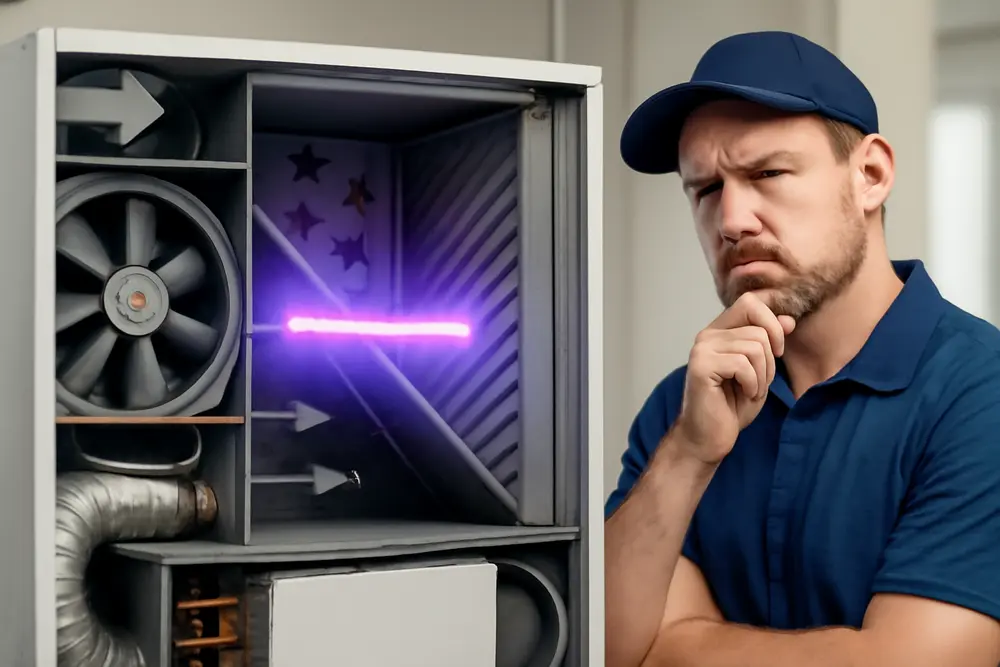
If you’ve ever stuck your head in an air handler and caught a whiff of gym sock stew, you already know coils and drain pans are mold’s favorite Airbnb. Cue the air handler UV-C sales pitch that promises crystal-clean coils, perfect air, and eternal HVAC bliss. I restore water and mold messes for a living, and I love UV-C when it’s used right. I also rip it out when it’s slapped in like a glow stick and expected to do miracles. Here’s the straight talk on when air handler UV-C helps and when it’s just hype, with real numbers and field-tested tips.
What Mold Loves In Coils And Pans
Coils are damp, shaded, and dust-coated. That combo becomes biofilm fast. Fins trap organic bits, condensate feeds them, and airflow is too low inside the fin pack to dry things out. The drain pan is the afterparty. Water pools, algae shows up, and spores catch a free ride back into the airstream every time the blower kicks on. If relative humidity indoors rides over 60 percent, the coil stays wetter longer and the pan never really dries. That’s a growth plan, not a cooling plan.
How UV-C Actually Works
UV-C around 254 nm scrambles microbial DNA and RNA. To get results, you need dose, which is irradiance times time. Surface targets like wet coils and pans can get enough time because the light sits there cooking biofilm continuously. Airborne targets blasting past a lamp get only fractions of a second, which usually isn’t enough unless you bring serious output and smart design. UV-C is suppression and prevention on surfaces, not an eraser for thick, fuzzy mold mats.
Where Do Lamps Go For Real Results
Put lamps downstream of the cooling coil so they shine back onto the coil face and into the drain pan. That’s the high-value zone, because it stays wet and grows slime. Lamps upstream or lost in straight duct often miss the wettest surfaces and blow your dose. Aim for even coverage across the coil face and a clear line of sight to the entire pan. Watch for shadowing from structural members, mist eliminators, or double-wall liners. If you cannot see it, UV cannot treat it.
Real example from a mid-rise office job: we installed a two-lamp rack 8 inches off a 30 by 24 inch coil, angled so the bottom lamp washed the pan. Growth on the coil face and pan film dropped visibly in weeks, and the next season pressure drop stayed flatter because biofilm didn’t rebuild. Same building, an upstream lamp in a sister unit barely touched coil slime and the pan still looked like split-pea soup. Placement mattered more than the brand on the box.
What Dose Does The Job
Research on coils points to continuous irradiance in the neighborhood of 150 to 300 microwatts per square centimeter on the coil surface. That range has shown roughly half or better cuts to microbial loading under condensing conditions when it’s maintained across the surface. If your lamps are weak, far away, or dirty, the number collapses and so does the benefit. High humidity also knocks UV effectiveness down a peg.
Practical targeting tips that hold up in the field:
- Design for uniform surface irradiance on the coil face and over the entire drain pan, not just a hot spot in the center.
- Distance matters. Closer lamps raise irradiance but also increase shadowing. Many racks land 6 to 12 inches off the coil, then get tuned for coverage. Verify with a UV radiometer when possible.
- Lamp sleeves and reflectors help, but they must be kept clean. Dust and nicotine film steal dose fast.
- Lamp output drops with age and cold air. Expect annual replacement for typical low-pressure lamps that are rated around 9,000 hours of useful life.
Will UV Clean Your Air In Flight?
Mostly no, not with the kind of modest systems installed in standard handlers. Here’s why. Air across a coil often runs near 500 feet per minute. If a lamp field is 6 inches deep, air spends about 0.06 seconds in the UV zone. Many microbes need fluence in the millijoule per square centimeter range. Hitting 10 mJ/cm² in 0.06 seconds means an average intensity of roughly 167,000 microwatts per square centimeter. That dwarfs the 150 to 300 microwatts per square centimeter that works fine for surfaces. So yes, UV can help the airstream if the design is built for it, but most coil racks are surface treatments, not airborne disinfection systems. For actual in-air reduction, pair high-grade filtration with well-engineered UV and validate performance, or look at upper-room UV in the occupied space.
Safety You Should Not Skip
UV-C damages eyes and skin, so protect your crew and your customers. Install interlocks that shut lamps off when access doors open. Label access panels. Keep lamps sealed in the AHU and never mount ozone-producing 185 nm bulbs in ducts unless they’re filtered or certified as ozone-free. Look for UL-2998 or equivalent low-ozone claims from reputable manufacturers. Train techs to lock out power, wait for lamps to cool, wear sleeves and UV-rated eye protection, and avoid reflective surfaces during service. If you smell sharp, chlorine-like air in the cabinet, kill power and check for the wrong lamp type or broken quartz.
UV-C vs Cleaning And Humidity Control
Here’s how air handler UV-C stacks up against old-school scrubbing and smart moisture management.
| Aspect | Air Handler UV-C | Mechanical Cleaning And Humidity Control | Watch Outs |
|---|---|---|---|
| Coil and pan biofilm | Continuous suppression on surfaces and less rebuild between service | Immediate removal of gunk and works in shadows where UV cannot reach | Heavy buildup needs cleaning first, then UV holds the line |
| Airborne spores | Limited in typical handlers, better only with high-dose designs | Filtration captures spores and humidity control slows growth upstream | UV racks for coils are not full airstream sanitizers |
| Energy and efficiency | Clean coils transfer heat better, some sites see 5 to 15 percent savings | Clean coils and proper RH improve airflow and comfort | Lamp power and replacements add cost and need scheduling |
| Cost and upkeep | Annual lamps, periodic sleeve cleaning, verify dose over time | Labor-heavy coil cleaning and RH control increases equipment and energy | Performance drops with dirty lamps, poor placement, or ignored RH |
In real projects we clean first, fix moisture issues, then use UV-C to keep surfaces from sliding back into slime. That stack beats any single tactic.
When Does Air Handler UV-C Make Sense
UV-C shines in handlers that stay wet and run long hours. Think hospitals, data centers with tight setpoints, supermarkets, hotels, and coastal or humid markets where coils rarely get a dry-off. In a coastal condo that fought pan algae every summer, we cleaned the coil, adjusted the trap and pitch, tightened infiltration that was pulling humid air into the return, then added a coil and drain pan UV treatment. The pan stopped growing a green beard and the owner stopped calling for mid-season cleanings.
Could UV-C help a small residential unit in a dry climate that runs only a few months a year? Maybe, but the return on spend is usually weaker. You’ll get more punch from sealing returns, upgrading filtration, maintaining proper refrigerant charge, pitching and trapping the pan correctly, and keeping indoor RH below 60 percent. If you still see recurring slime, then add UV-C with the right placement and dose, not a random glow stick zip-tied to sheet metal.
How To Spec And Maintain It
If you want UV-C to earn its keep, start with a clean slate. Remove heavy growth mechanically and rinse thoroughly. Fix the root moisture issues like a flat pan, missing trap, or leaky return pulling attic humidity. Then spec lamps to deliver continuous 150 to 300 microwatts per square centimeter on the coil face and full coverage on the pan. Confirm coverage with measurements or a reputable design submittal that references irradiance at the surface, not just lamp wattage.
Build a maintenance plan from day one. Quarterly visual checks, wipe sleeves if fouled, test interlocks, and log lamp hours. Replace lamps on schedule, not when they burn out. If you see cold spots on the coil face, add lamps or adjust spacing. If the cabinet RH is sky high, improve airflow and condensate management because UV fights harder and costs more when everything stays soggy.
UV-C FAQ
Will air handler UV-C kill all mold in my ducts?
Not likely. It suppresses growth where it shines, mainly coil and pan surfaces. Duct runs with dust and shadows still need cleaning and filtration.
Can I skip coil cleaning if I install UV-C?
No. UV-C does not peel off thick biofilm. Clean first, then let UV-C keep it from coming back as fast.
Does lamp brand matter?
Yes. You want 254 nm output, proper fixtures, real data on irradiance, and third-party ozone-free claims like UL-2998. Cheap lamps that leak 185 nm can make ozone, which you do not want in an AHU.
Is a single lamp enough for a big coil?
Usually not. Large or deep coils need multiple lamps to reach the edges and inner fin pack. Design for measured surface irradiance, not just total watts in the cabinet.
Can UV-C lower my energy bill?
Cleaner coils reduce pressure drop and improve heat exchange. Sites often report single to low double-digit savings once slime stops rebuilding, but results depend on system condition and run time.
Bottom line from the trenches. Air handler UV-C helps when it’s aimed at wet coils and the drain pan with enough dose and basic safety built in. It’s not a silver bullet for airborne bugs at typical duct speeds. Clean first, control humidity, then let UV-C hold the line so your coils stay clean and your pan quits growing a salad.