
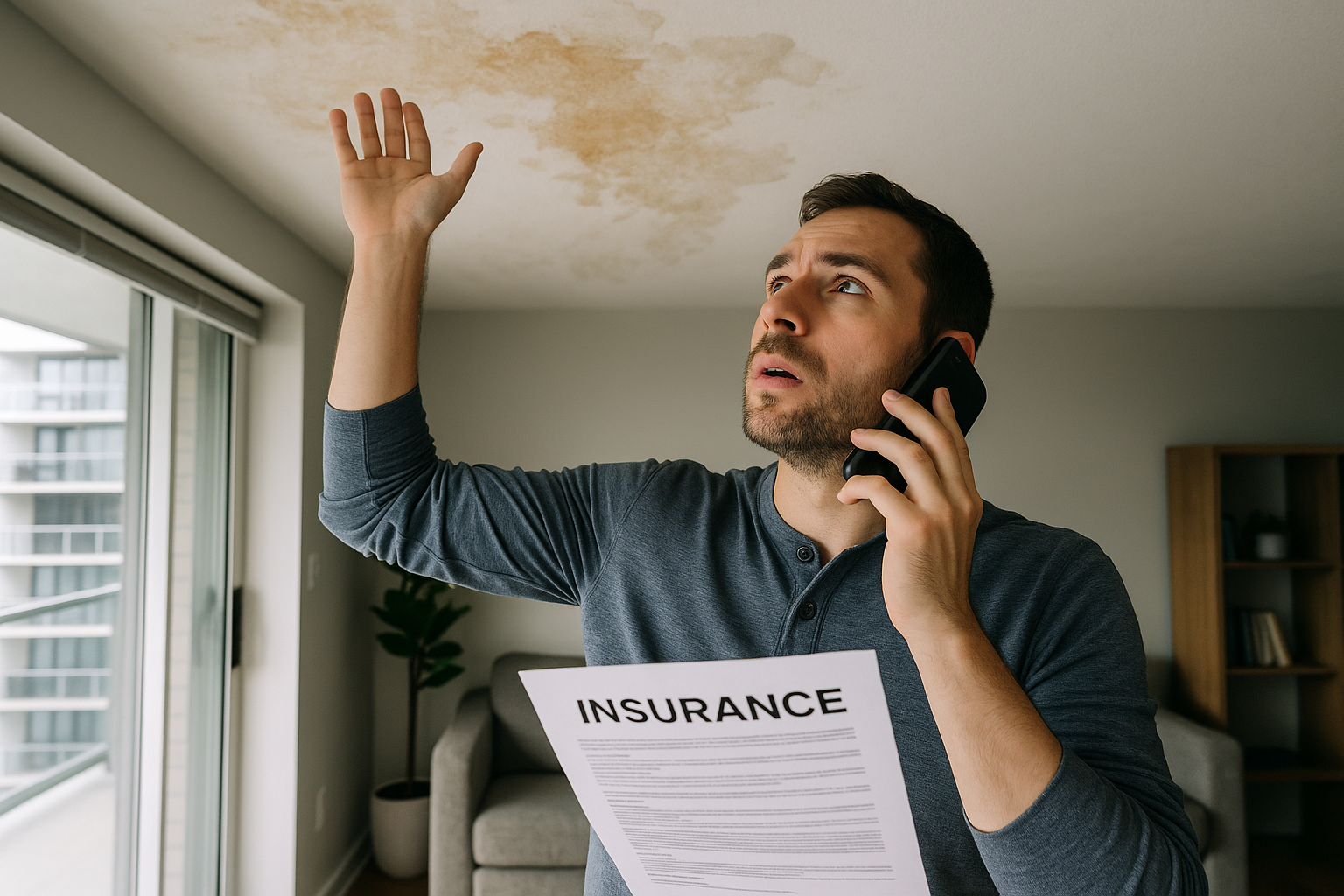
Water from the upstairs unit is dripping through your ceiling. The floor feels slick, your smoke detector is chirping, and you are already wondering who pays for this. This guide shows you exactly what to do in the first hour to limit damage, how condo master policy vs HO6 coverage usually divides responsibility, how to document your loss for claims, and how to dry fast to avoid mold in shared walls and ceilings. If you need help right now in Austin, our team handles emergency water damage restoration, full documentation, and repairs while you work with the HOA and insurers. HOA water leak responsibility questions are common, and the steps below will help you move from shock to action quickly.
First actions when a neighbor leak floods your unit
Your priority is to stop ongoing water, keep people safe, and start a paper trail that shows what happened and when. If you can safely reach a shutoff valve, do it. If you cannot, call the building manager, maintenance, or your neighbor right away while you start photos and videos. If there is standing water near outlets or appliances, do not touch cords or switches. If you smell burning plastic, hear arcing, or see sparking, back away and call the fire department. Safety comes first.
As soon as those basic steps are underway, call a restoration company for extraction and drying. Fast action can be the difference between simple drying and a full mold remediation. Our local crews handle extraction, containment, moisture mapping, and daily drying logs that carriers expect to see. Call our 24 7 team at (512) 326 2633 or tap our page for emergency water damage restoration.
If a sprinkler head discharged or a pipe in a shared wall burst, skim this detailed checklist for stopping the flow and first day tasks in our guide to sprinkler discharge cleanup.
Condo master policy vs HO6 coverage
In most condominiums, the association purchases a master policy for the building and common elements, while each unit owner carries a condo insurance policy known as HO6. In plain terms, the master policy typically insures the building structure and shared areas, and your HO6 insures your belongings, your interior finishes depending on the master policy type, and your personal liability. Progressive offers a simple overview of this split, and it is a good starting point for understanding the basics of HOA water leak responsibility. See their guide to condo insurance at Progressive.
The exact split depends on the master policy wording. Insuranceopedia outlines three common master policy types that most associations use. Those types determine who insures drywall, studs, built in cabinets, and interior finishes. You can review their clear explanation at Insuranceopedia.
Common master policy types
Always check your association governing documents and the master policy declaration page. Policy language controls in a claim, and associations vary. The table below gives general guidance based on commonly used terms in the insurance industry.
| Master policy type | Master policy generally covers | Your HO6 generally covers |
|---|---|---|
| Bare walls | Structure up to bare studs and common elements including roof, framing, exterior walls, shared plumbing risers | Interior finishes such as drywall paint trim flooring cabinets appliances fixtures along with personal property and loss of use |
| Single entity | Structure and original builder grade finishes inside units such as original drywall and built in features | Upgrades and improvements inside your unit over builder grade personal property and loss of use |
| All in | Structure plus interior fixtures and finishes inside units as originally installed | Personal property upgrades improvements and loss of use |
These categories guide who pays to rebuild a water damaged wall or vanity, but they do not decide fault. Responsibility to pay for the loss can also depend on deductibles, negligence, and whether multiple units were affected. Two owners can live side by side under the same HOA and still have very different claim paths because of deductible rules or policy types. For a friendly explainer with real examples of HOA deductibles and gaps, see the Vargas and Vargas Insurance article at Vargas and Vargas Insurance.
Who pays in real world scenarios
Only your unit is damaged and the master policy has a high deductible. If the cost to rebuild is below the association deductible, the master carrier may not pay. In that case, your HO6 may be the fastest path for interior finishes and personal property, subject to your deductible and policy limits. Your carrier can later seek recovery from the HOA or neighbor if they were negligent.
Several units are affected after a pipe breaks in a common wall. If the association carries a single entity or all in policy, the master policy is often primary for interior repairs. Your HO6 would still handle your personal property, loss of use, and any upgrades above builder grade. The association may later levy a loss assessment to share part of the master policy deductible among owners. Loss assessment coverage is a feature in many HO6 policies that can help with these charges. The Merlin Law Group offers a clear explanation of loss assessment coverage and how it applies in condo claims at Merlin Law Group.
A neighbor leaves a sink running and water floods through a party wall into your unit. Your HO6 can cover your interior finishes and personal property according to your policy language. If the neighbor was negligent, your insurer may pursue subrogation against the neighbor or the master carrier later. This is common behind the scenes and does not delay urgent mitigation.
Bottom line. Read your master policy type, know the HOA deductible, and review your HO6 limits for building items and loss assessment coverage. If you do not have a copy of the master policy declaration page, request it from the board or manager right away.
How to document your loss for claims
Good documentation helps your adjuster understand the scope and speeds approvals. It also protects you if the HOA or a neighbor disputes the facts later. Start with wide photos of each room, then move to close ups of impacted areas and contents. Keep the original timestamps on your files. Video walking tours help show the sequence of damage from the source area to the farthest room.
Make a folder on your phone or a cloud drive and keep these items together.
- Photos and videos with timestamps before any cleanup begins
- Serial numbers for electronics and appliances that got wet
- Receipts or statements for damaged contents and finishes
- Moisture readings and daily logs from your restoration contractor
- Emails you sent to your neighbor, HOA, property manager, and insurer with date and time
- A written note with the time you first saw water, when you called for help, and any witness names
Share this package with your HO6 carrier promptly even if you believe the master policy will pay. Many HO6 carriers will pursue recovery from the HOA or neighbor if they were at fault. Proper mitigation logs and photos support both your claim and any recovery down the line. For a handy first day checklist and what adjusters look for, see our sprinkler discharge cleanup guide at sprinkler discharge cleanup.
Why fast drying matters to prevent mold
Mold growth can begin within roughly two to three days on wet drywall, particle board, carpet pad, and insulation. The Centers for Disease Control and Prevention warns that porous materials left wet can support microbial growth and may need removal if not dried quickly. See CDC guidance at CDC mold cleanup and prevention.
Professional mitigation reduces secondary damage and keeps the project in a simple repair category whenever possible. A standard drying plan includes water extraction, source isolation, containment to keep clean areas clean, removal of saturated unsalvageable materials, application of appropriate antimicrobial where indicated, dehumidification, directed air movement, and daily moisture readings to track progress. Our teams produce moisture maps with before and after readings that adjusters rely on. If you are in Central Texas, call our 24 7 line at (512) 326 2633 or visit our page for emergency water damage restoration.
Shared walls and ceilings deserve special attention. Water can travel along framing and piping, which means a dry looking surface may still hide moisture in a cavity. Infrared cameras and pin type and pinless meters help identify wet areas that need opening for proper drying. Skipping this step is the fastest way to end up with mold behind a baseboard or inside a party wall.
Working with your HOA and neighbor
Notify your neighbor and the association in writing with photos and a brief timeline. Keep everything professional. Most boards and managers want to resolve water issues quickly because delays raise costs for everyone. Here is a simple order that tends to work well. Reach the neighbor if you can, call the property manager or HOA office, call your HO6 carrier, and call a qualified restoration company. If your building has maintenance on site, loop them in for shutoff help.
Ask the manager for the master policy type and current deductible. Some associations carry very high deductibles or apply a per unit deductible. If the master deductible is higher than the repair cost for one unit, the master carrier may not pay and the owner would need to use their HO6. This is a common reason owners are surprised by out of pocket costs after a leak. The Vargas and Vargas Insurance article linked above gives examples of how this plays out and why loss assessment coverage on your HO6 can help with HOA billed deductibles.
When several units are involved, the association will often open a claim under the master policy and coordinate unit access. You can still use your preferred restoration company if your HOA documents allow it, and you should still report the loss to your own carrier. Adjusters frequently sort out billing and subrogation later. Your job is to stop damage, document the condition, and keep drying moving.
Mold prevention and health
Limit exposure to areas with visible mold or a musty odor until drying and cleanup are complete. Use simple protective gear when handling wet materials. Non vented goggles, nitrile gloves, and an N95 or better respirator are common choices for small cleanup tasks. The CDC recommends discarding porous items that stayed wet for more than about two days, such as carpet pad, saturated drywall, and insulation. For larger areas, or for spaces with shared cavities and complex assemblies, call a professional remediation team. See CDC cleanup guidance at CDC mold guidance and worker safety notes at OSHA.
Never run air movers in a closed wall or ceiling cavity without a way for wet air to escape. That can push moisture deeper and spread spores. Proper containment and negative pressure help keep clean rooms clean while work proceeds in the affected zones.
If the leak originated above your unit, water may have tracked through the attic or a chase. Review our tips on attic water damage and mold prevention for signs to watch for after the initial dry down.
Email templates you can copy and send
When speed matters, a clear message with photos helps everyone move faster. Edit the templates below with your details. Send by email and text if you have a mobile number for faster contact.
Message to neighbor
Subject: Water leak affecting my unit
Hello,
I am seeing water coming through my ceiling and wall near our shared line. I first noticed it at [time] on [date]. I believe it may be coming from your unit or from a shared line above us. I have attached photos and a short video.
Please call or text me at [your number]. I have contacted the property manager and started emergency mitigation to prevent further damage and mold.
Thank you,
[your name]
[your unit number]
Message to HOA or property manager
Subject: Urgent water leak and claim notice for unit [your unit]
Hello [manager name or board],
I discovered water intrusion at [time] on [date]. Source appears to be [upstairs unit, shared wall, sprinkler discharge, unknown]. Multiple photos and a brief video are attached. I contacted my neighbor and called a licensed restoration contractor to start emergency extraction and drying. Please advise the current master policy type and deductible so we can coordinate claims. I will provide moisture logs and daily updates.
Contact info
Name
Unit and address
Phone and email
Message to your HO6 carrier
Subject: Claim notice for water damage from adjacent unit
Hello,
I am reporting water damage discovered at [time] on [date]. The source appears to be [describe]. I have attached photos and video. Emergency mitigation started at [time] with [contractor name]. Please advise next steps. I will share the HOA master policy details when I receive them. I understand subrogation may apply and will cooperate fully.
Policy number
Best contact times
Message to your restoration contractor
Subject: Emergency water extraction needed at [address]
Hello,
I have active water from [source if known]. Please dispatch for extraction and drying as soon as possible. This is a condo unit with shared walls and ceilings. The HOA and my insurer have been notified. I will need moisture mapping, daily readings, and photos for claims.
Gate or access details
Parking instructions
Any pets on site
What a solid mitigation scope should include
Insurance adjusters want to see clear cause and effect, proper containment, and proof that the structure reached dry standard. Ask your contractor to include these items in the scope and in the final package sent to you and your adjuster.
- Source description and a simple sketch of affected rooms
- Moisture map with initial and daily readings, including shared walls and ceilings
- Photos of each affected area before work starts, during drying, and after removal
- List of materials removed such as baseboards, drywall, insulation, cabinet toe kicks
- Equipment list with model counts and placement notes
- Drying goals and the day the structure hit dry standard
- Sanitizer or antimicrobial used and where it was applied when appropriate
- Copies of email updates sent to the HOA or manager if required
This level of documentation speeds claim reviews and reduces back and forth. It also makes it easier to settle any dispute about whether a wall cavity was opened and dried properly.
Common questions about HOA leaks and insurance
Who pays when my upstairs neighbor floods my condo?
It depends on the master policy type, the HOA deductible, and whether the neighbor was negligent. The master policy typically covers the building structure and sometimes original interior finishes, while your HO6 covers your belongings and often interior finishes. See the basic split at Progressive and master policy types at Insuranceopedia.
What is an HOA or master insurance deductible and can the HOA bill me?
Many master policies carry high deductibles, and some apply a per unit deductible. If a loss triggers the master policy, the HOA may assess owners for part of that deductible. Loss assessment coverage on your HO6 can help with those charges. See examples at Vargas and Vargas Insurance and legal perspective at Merlin Law Group.
Does my HO6 cover water damage caused by another unit?
Often yes for your interior finishes and personal property, subject to your policy and deductible, even if the source was in another unit. Your carrier may later pursue recovery from the neighbor or the HOA if they were at fault. See HO6 coverage basics at Progressive.
How soon must I start drying to prevent mold?
As soon as possible. Mold can begin to grow within about two to three days on wet porous materials. Fast extraction, removal of saturated materials, and controlled drying lower the risk. See CDC guidance at CDC mold cleanup and prevention.
What documentation should I gather for an insurance claim?
Photos and video with timestamps, receipts, a room by room inventory of damaged items, mitigation logs with daily moisture readings, and all emails and texts with the HOA, neighbor, and carriers. This package supports both your claim and any recovery action your insurer pursues.
Can my insurer subrogate against the HOA or the neighbor?
Yes. If they believe another party caused the loss or is responsible under contract, your carrier may seek recovery after they pay you. This does not stop you from drying right away. File your claim and let the insurers sort out responsibility once the property is protected.
Insurance tips that spare you headaches later
Ask for the master policy declaration page and the specific master policy type in writing. Check your HO6 building coverage limit and loss assessment coverage and consider whether those limits match your finishes and your potential share of any HOA deductible. Save all invoices and mitigation logs. Share updates with your adjuster regularly. If there is a dispute about responsibility or if you receive a large loss assessment, consult a qualified attorney for help. If anyone in your household has breathing challenges or mold sensitivity, speak with a healthcare professional about precautions.
Local help in Austin
Water in a condo spreads quickly through shared walls and ceilings. Drying fast and documenting the scene well are the two biggest ways to keep repairs simple and keep claims on track. If you are in Central Texas and need rapid response plus clean documentation, call our 24 7 team at (512) 326 2633 or visit our page for emergency water damage restoration. For targeted guides on common causes and prevention tips, see our water damage guides, including sprinkler discharge cleanup and attic water damage and mold prevention.
A quick recap you can act on today
Stop the water if you can do so safely, call for help, and start your photo and video log right away. Report the loss to your neighbor, your HOA, and your HO6 carrier, then let the carriers sort out responsibility while you protect the property. Dry quickly to prevent mold, open shared cavities that test wet, and keep daily moisture logs. Ask your HOA for the master policy type and deductible in writing, check your HO6 limits and loss assessment coverage, and keep every email and receipt. If you want a ready made first hour checklist, call us and we will send a printable version and dispatch a crew. We are here around the clock to help with extraction, drying, documentation, and full repairs.
Sources you can review for further reading
Progressive: What is Condo HO6 Insurance
Insuranceopedia: Condo HO6 and master policy types
Vargas and Vargas Insurance: HOA deductibles and gaps
Merlin Law Group: Loss assessment coverage
CDC: Mold prevention and cleanup guidance
OSHA: Mold cleanup and worker protection
Disclaimer
Condo insurance and HOA rules vary by association and by state. Always review your CC and Rs, bylaws, and policy documents and speak with your adjuster for guidance on your claim. For legal questions about responsibility, assessments, or disputes, consult an attorney. For health concerns related to water damage or mold exposure, consult a healthcare professional.