
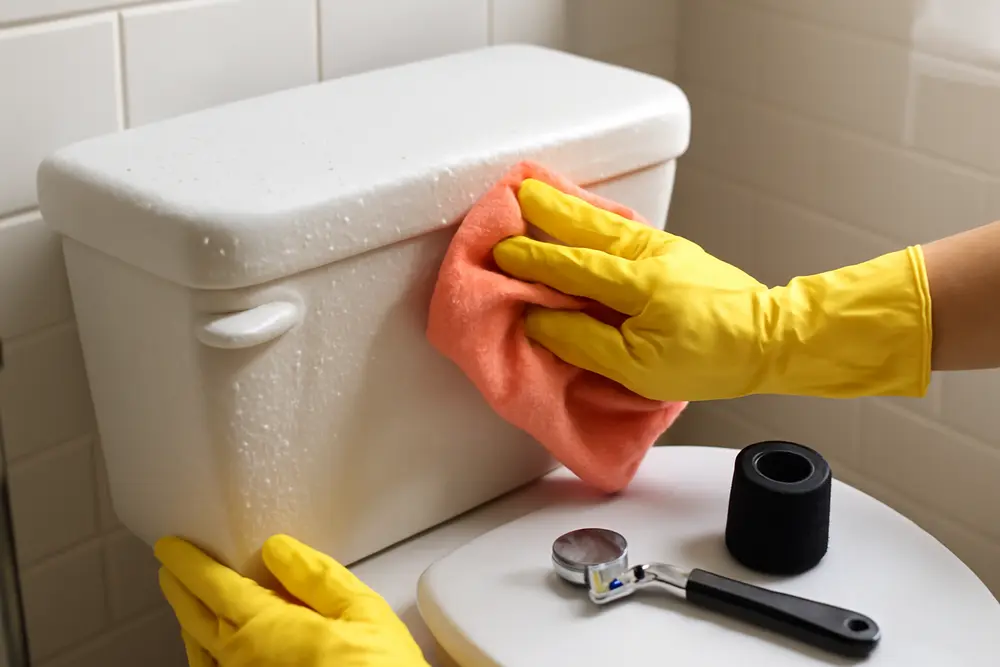
Your bathroom floor is wet again, and the toilet swears it didn’t do it. No cracked tank. No leak at the base. Yet there’s a puddle that keeps showing up like a bad sequel. Here’s the plot twist most homeowners miss: your toilet and cold water pipes are sweating. Warm, humid air hits a chilled surface, water drops out of the air, and boom, you’ve got mystery puddles. The fix is not magic or expensive in most cases. It’s humidity control, pipe insulation, a smart valve or two, and a little attention to ventilation. As a restoration pro who spends too much time rebuilding mushy subfloors, I’m telling you straight: if you stop the condensation now, you won’t be paying for rot and mold later.
Why Toilet Tanks Sweat
Toilet tank sweating is just condensation wearing a porcelain trench coat. When the tank refills with cold water, the porcelain cools down. Warm, humid bathroom air touches that cold tank and releases moisture. Those droplets roll off the tank, hit the floor, and soak into grout, baseboards, and the edges of your vinyl or laminate. The same physics applies to that chilly copper or chrome supply line coming out of the wall. Cold surface plus humid air equals puddles. No cracked porcelain. No secret flood. Just dew point doing what dew point does.
Humidity spikes in bathrooms for two big reasons. First, hot showers add moisture to the air. Second, a lot of bathrooms have weak or nonexistent exhaust ventilation, so the moist air lingers. If the toilet is also running a little bit because of a worn flapper, it constantly brings in new cold water, which keeps the tank extra chilly. That’s basically an invitation for your tank to sweat like it jogged to Congress Avenue in August.
How Condensation Wrecks Floors
Condensation looks innocent, but it’s brutal on finishes and subfloors. Repeated wetting makes wood swell and soften. Laminate starts to lift at the edges. Vinyl tile loosens. Grout darkens. Caulk lines crumble. Fasteners and hardware corrode. And because moisture loves to sneak into the gaps where the toilet base meets the floor, you can get mold growth where you can’t see it. In a warm climate like Central Texas, mold can get rolling in as little as 24 to 48 hours. By the time you smell that musty note, the damage has already made itself at home under your feet.
I get called when those little daily puddles turn into spongy floors, buckled baseboards, or a toilet that rocks because the subfloor is rotting. Nobody wants to hear the words cut out and rebuild when we could have stopped the moisture at the source with simple pipe condensation prevention.
Quick Fixes You Can Do Today
Start with the low-hanging fruit. If your toilet has been whispering sweet trickle sounds at night, do a flapper check. Put a few drops of food coloring in the tank and wait 10 to 15 minutes without flushing. If the color shows up in the bowl, your flapper is leaking. Replace it. They’re cheap, and a fresh flapper stops the constant stream of cold refill water that keeps the tank like an ice bath.
Look at the water level in the tank. If it’s topped off like a gas tank before a road trip, adjust the float down a bit. Less water means less mass to keep cold. Don’t go too low or you’ll lose flush performance. Aim for about an inch below the top of the overflow tube unless your manufacturer specifies differently.
Turn on the exhaust fan whenever you shower and let it run 20 to 30 minutes afterward. That’s not overkill. Steam hangs around. If your fan sounds like a lawnmower but moves as much air as a tired hamster, it might be undersized or clogged. Bathrooms usually need a fan rated around 1 cfm per square foot for 8-foot ceilings. Clean the grille and make sure it actually vents outside, not into the attic.
For same-day damage control, place an absorbent mat around the base of the toilet, or set a slim tray behind the tank to catch drips while you work on a permanent fix. Wipe the tank dry after showers. Drop a small hygrometer on the vanity to learn your real indoor humidity. Try to keep it around 40 to 50 percent if you can. If your AC is set too high in summer and the bathroom bakes, dial it down a couple degrees to cool the room and reduce relative humidity.
Permanent Fixes That Stick
If your bathroom is a humidity hotspot or your home’s incoming water is frigid, do something that changes the physics in your favor. The big winners are mixing valves, insulation, better ventilation, and dehumidification. Pick the approach that matches your home, budget, and access to plumbing.
| Method | How It Helps | Best For | What To Know |
|---|---|---|---|
| Anti-sweat mixing valve | Blends a touch of warm water into the cold supply so the tank refill is less chilly | Homes with very cold incoming water or persistent tank sweating | Requires plumbing access; usually a few hundred dollars installed depending on access and labor |
| Tank insulation kit | Foam liner glued inside tank slows heat transfer so the outside stays warmer | DIY-friendly fix when plumbing changes are tough | Use closed-cell foam; follow glue directions; may slightly change flush acoustics |
| Pipe insulation | Foam sleeves on cold supply lines keep humid air off the cold metal | Condensation on exposed supply lines or basement pipes | Seal seams; don’t cover shutoff handles; replace if it gets soggy or moldy |
| Ventilation upgrade | Stronger exhaust pulls moist air out fast so it cannot condense | Small, steamy bathrooms or no existing fan | Vent outside, not into attic; use a timer switch so it actually runs |
| Dehumidifier | Removes moisture from air to lower dew point below tank temperature | Humid climates or bathrooms without easy ducting options | Empty the bucket or plumb a drain; set target RH around 45 percent |
Anti-sweat mixing valves are the heavy hitters. They add a small amount of warm water to the cold line feeding your toilet so the refill temperature lands above your room’s dew point. Less temperature difference means fewer droplets. A plumber can usually mount one under the sink or in an accessible line, and you can fine-tune the blend so you are not wasting hot water. It’s a set-it-and-forget-it solution for families who take lots of hot showers or for homes on wells with chilly supply water.
Insulation kits are the weekend warrior option. You drain the tank, dry it completely, cut foam panels to fit the interior walls, and glue them in place. When the tank refills, the outside porcelain does not chill as much, which tames sweating. Not all kits are equal. Choose closed-cell foam, use the right adhesive so you do not dissolve the foam, and let it cure fully before refilling. If your tank sweats like crazy, pair a liner with better ventilation for best results.
Pipe insulation is a no-brainer for exposed lines. Snap-on foam sleeves for the supply line keep humid air away from the coldest metal in the room. Seal the seams with tape and trim neatly around the shutoff valve. If you have long stretches of cold piping in a crawlspace or garage that drip in summer, insulate them too. It is cheap and effective pipe condensation prevention.
If your ventilation is weak, upgrade it. A quiet, high-efficiency fan on a humidity-sensing switch will kick on automatically when showers raise the moisture level. Vent it outside with proper ducting so you are not dumping steam into your attic. Use a 20 to 30 minute timer post-shower. Ventilation is the fix that keeps solving other problems you did not even know you had, from mirror fog to peeling paint.
Finally, a dehumidifier is the blunt instrument that just works when your room keeps cycling humidity faster than your fan can remove it. In a bathroom, a compact unit can sit on a low shelf and drain into a shower or sink with a little hose. In larger or more humid homes, a whole-house or closet-mounted unit can pull moisture down to that sweet 45 to 50 percent zone.
Is It Condensation or a Real Leak?
Before you go all in on anti-sweat strategies, make sure the water is not from an actual leak. Condensation usually shows up as droplets on the outside of the tank or line, then a slow widening puddle on the floor that appears after showers or during muggy weather. If you run the fan and air conditioner for an hour and the tank stays dry, you are probably fine. If water keeps appearing even in cool, dry conditions, investigate.
Check the supply line connection at the wall and where it meets the fill valve under the tank. Run a dry tissue around both connections to see if it picks up moisture. Look under the tank bolts for drips. Shine a flashlight at the shutoff valve packing nut. If the base of the toilet shows water weeping from the wax ring after every flush, that is a leak that needs a plumber, not an insulation kit. Also inspect the tank for hairline cracks by drying it fully and watching carefully while it refills. If you see beads forming from one spot like a little constellation, that is not condensation.
What About Cold Pipes?
Toilet tanks get all the attention, but cold pipes can be just as sneaky. In summer, that chilly copper line running along a garage wall or in a basement can sweat like a cold beer on a picnic table. Water drips, puddles form, and before long you have rust on hangers and stains on drywall. For exposed lines, snap-on foam insulation solves most of it. Seal joints well. If the line feeds a toilet and you still see beads forming right at the compression fittings, insulate as close as you can and keep the bathroom humidity under control with ventilation or a dehumidifier. In some cases, moving a supply line a few inches away from an AC supply register helps because it is not getting hit by cold air blasts that push it below the room’s dew point.
Austin Factors To Consider
In Central Texas, summer humidity loves to flex. Indoor relative humidity often sits above 50 percent once the showers start and the AC runs. Cool air from your vents lowers air temperature faster than it lowers moisture content. That bumps the relative humidity up, which pushes you closer to the dew point. The net effect: toilet tank sweating goes from rare party trick to daily routine. If your bathroom has no window or a weak fan, you are basically marinating your tank in a cloud all season.
What works well in Austin homes is a layered approach. Stop any toilet run-on so the tank is not ice cold all day. Insulate exposed supply lines. Upgrade the fan or at least run it long enough to clear moisture. If your home has well water or very cold municipal supply, install an anti-sweat mixing valve. Use a hygrometer to keep tabs on humidity and aim for that 45 to 50 percent zone. If you keep fighting fog every morning, a small dehumidifier is worth its weight in saved subfloor.
When To Call a Pro
If you mop water near your toilet more than once a week, or you notice a musty smell, soft flooring, stained baseboards, or darkened caulk around the base, bring in help. Our team at Austin Hi-Tech Restoration lives for moisture mysteries. We use moisture meters and thermal cameras to check the subfloor, drywall behind the toilet, and the area around the flange. If we catch damage early, targeted drying and a few small repairs get you back to normal. If rot or mold has already spread, we can handle the removal, drying, and rebuild properly so the problem does not come back.
We are also happy to be the practical friend who tells you which solution fits your bathroom. Sometimes you need a mixing valve. Sometimes you just need a better fan and a flapper. Either way, if the bathroom keeps sweating like a sauna, we will help you stop the drip before it turns into a full-blown repair job.
FAQ: Toilet Tank Sweating
Why is my toilet sweating only after showers?
Hot showers spike humidity. The air gets saturated, then hits your cold tank and supply line. Condensation forms. If you run the exhaust fan during and 20 to 30 minutes after showers, and keep the bathroom door slightly open, you will lower humidity enough to reduce or stop sweating.
Will a toilet tank cover stop sweating?
Fabric covers hide the problem but usually make it worse by trapping moisture against the porcelain. You want to reduce humidity or warm the refill water slightly. Use a tank insulation kit inside the tank or install an anti-sweat mixing valve. Those actually change the conditions that cause condensation.
Is an anti-sweat valve safe for my plumbing?
Yes when installed correctly. It blends a small amount of warm water into the cold line feeding only the toilet. It will not scald or affect other fixtures when set up properly. A licensed plumber can mount and adjust it based on your home’s water temperature and humidity.
Can I just lower my home’s humidity instead?
Absolutely. Good ventilation and a dehumidifier will tame bathroom humidity. Aim for indoor relative humidity around 40 to 50 percent. Even a small change can keep your tank surface above the dew point, which is the line where condensation starts.
Does tank insulation make the water smell or grow mold?
Not if you install it clean and dry using closed-cell foam and the right adhesive. Let it cure fully before refilling. If moisture ever gets behind the liner because of a poor glue job, you could see odors over time. Take your time on the install and you will be fine.
How do I know my fan is big enough?
As a simple rule, bathrooms need roughly 1 cfm per square foot for 8-foot ceilings. A 70 square foot bath needs around 70 cfm. High ceilings or long ducts need more. If the mirror stays fogged for more than a few minutes after a shower, upgrade the fan or lengthen the run time.
Will insulating the supply line really help?
Yes. That metal line is a condensation magnet. A snug foam sleeve keeps humid air off the coldest surface in the room. Seal the seams and leave valve handles accessible. It is one of the fastest wins for pipe condensation prevention.
What if I rent and cannot modify plumbing?
Go for the reversible fixes. Run the fan longer, crack the door, use a dehumidifier, keep the AC a bit cooler during shower times, and insulate the exposed supply line with removable foam. Add a tank insulation kit if allowed. Ask the landlord to replace a worn flapper so the toilet is not running cold water all day.
Could sweating be a sign of a hidden leak?
Sometimes both happen at once. Do the dye test for the flapper, tissue test at connections, and run the fan to dry the room. If the tank still gets wet without a humidity trigger or you see water at the base after every flush, call a pro to check for a real leak.
Ready To Stop The Puddles?
Toilet tank sweating is fixable with smart steps: stop any toilet run-on, insulate what is cold, vent what is humid, and if needed, warm the refill slightly with a mixing valve. If you are in Austin and your bathroom has already started softening around the toilet or smells a bit funky, Austin Hi-Tech Restoration can test for hidden moisture, dry what is wet, and point you to the right long-term fix. Your floor will thank you, your subfloor will thank you, and your nose will definitely thank you.