
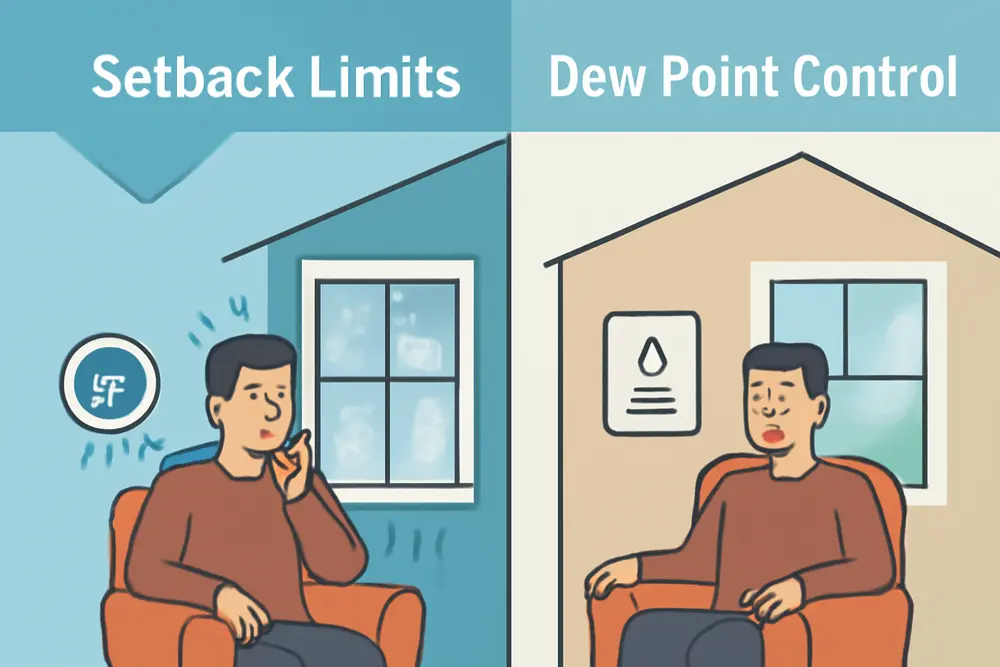
If you let your thermostat play yo-yo at night, your walls might be sweating like a gym locker by sunrise. Aggressive thermostat setback limits can spike indoor humidity, push dew point to dangerous levels, and leave you with overnight condensation on the coldest surfaces in the house. That combo is a mold starter kit. Here’s how dew point control, smart setbacks, right-size ventilation, and dehumidification keep the savings without growing fuzz on your drywall.
Why Setbacks Can Backfire
A thermostat setback is when you let the indoor temperature drift to save energy. With cooling, you raise the set point while you sleep or leave. With heating, you drop it at night or when you are out. Sounds smart until humidity jumps while the system is not actively dehumidifying or warming surfaces. As the air cools or sits with less conditioning, relative humidity rises. Dew point rises with it, and any surface that runs colder than the dew point will collect moisture. Think exterior corners, window frames, metal ducts, and the backside of furniture parked on exterior walls. That overnight sweat is not a badge of thrift. It is a mold risk.
Humidity, Dew Point, And Condensation
Relative humidity tells you how full the air is. Dew point tells you when water actually shows up. Dew point is the temperature at which air becomes saturated and condensation forms. Example time. At 70 F and 60 percent RH, the dew point is about 60 F. Any surface at 60 F or colder will sweat. That includes poorly insulated ducts, aluminum window frames, exterior corners with thermal bridging, or a north wall behind a bookcase. Dew point is the number to watch because it predicts when a surface will get wet. For a clear explainer on dew point and condensation, see the guide from Indoor Humidity at this link.
Mold Can Start Fast
Give mold moisture and a food source like paper-faced drywall or wood, and it can get established in 24 to 48 hours. We see it in hidden cold spots all the time, from attic framing around can lights to closet corners and supply boots that drip on sheetrock. Our HVAC and condensation write-up breaks down the usual suspects, from clogged condensate lines to uninsulated ducts, at HVAC leaks and condensation problems explained. We also have infrared examples of thermal bridging that create cold streaks where mold loves to start at infrared exposes thermal bridging mold.
Safe Thermostat Setback Limits
Energy savings are real. The U.S. Department of Energy reports that setting back or up by 7 to 10 F for eight hours can shave about 10 percent off annual bills. That works best in tight homes with good humidity control. In muggy seasons or mixed climates like Austin, go gentler. For cooling, keep night or away setbacks to about 4 to 6 F above your daytime set point, and only if humidity control holds. For heating, aim for a 5 to 7 F drop. The real guardrail is dew point. ASHRAE guidance for mechanically cooled buildings calls for indoor air dew point no higher than 60 F, occupied or not. You can review that limit in their addenda here at ASHRAE 62.1 addendum. If your setbacks push dew point above 60 F or bring cold surfaces within a few degrees of the dew point, you just traded a tiny utility win for a mold bill.
Dew Point Control That Works
Use hygrometers that show dew point or a phone app calculator alongside your temperature and RH readings. Keep indoor dew point at or below 60 F. Safer still, keep the coldest surface in a room at least 5 F warmer than the dew point. That buffer keeps condensation at bay even during setbacks. Grab an infrared thermometer to spot check surface temps at exterior corners, around windows, on supply registers, and behind big furniture. If you find surfaces getting within that 5 F zone, ease up on the setback or add dehumidification. A quick example. Bedroom air is 74 F at 55 percent RH which is a dew point around 57 F. If your window frame is 56 F, you are in the splash zone. Raise room temperature a couple degrees, dry the air using dehumidification, or both.
Ventilation And Dehumidification
Ventilation is about kicking moisture out, not dragging more in when the outdoor dew point is tropical. Run bath fans during showers and for 20 to 30 minutes after. Use a timer switch so it actually happens. Vent kitchen hoods outside. In Austin, when outdoor dew point is north of 60 F, skip the open-window night cool attempts. You are importing moisture. If your AC struggles to dehumidify during long setback periods, add a whole-house dehumidifier set to maintain 45 to 50 percent RH. Portables help in problem rooms, but they must be sized correctly and drained continuously. We outline broader humidity control moves here at humidity’s role and how to manage it. For attics and crawlspaces, seal air leaks and control moisture entry before you crank up ventilation, covered here at attic risks and prevention tips.
Insulation And Thermal Bridges
Even with perfect RH, cold bridges can drop a surface below dew point. Studs, steel beams, exterior corners, rim joists, and recessed light housings can run cold and sweat. That moisture then feeds mold on nearby paper and dust. Tactics that work. Air seal top plates, rim joists, and penetrations. Upgrade attic insulation and duct insulation, especially near supply boots. Add continuous rigid insulation during exterior remodels to break thermal bridges. Leave a gap behind big furniture on exterior walls so air can wash those surfaces. We share real thermal images and fixes here at thermal bridging and mold.
Balance Energy And Mold Prevention
You can have both savings and a dry house. Use smaller setbacks when it is humid, and larger ones when the air is dry. Pre-cool or pre-heat before occupancy while running dehumidification, then ease into a mild setback. In cooling season, leave the blower set to Auto so moisture stays on the coil and drains instead of re-evaporating back into the air. In heating season, a low continuous fan speed can help warm cold surfaces and even out room temperatures, which raises surface temps above dew point. If your system has a dehumidify mode or overcool to dehumidify feature, enable it within sane limits.
What To Monitor And Tools
Place small hygrometers in bedrooms, closets on exterior walls, and near problem corners. Data loggers are even better because you can catch those 2 a.m. humidity spikes. Keep RH between 30 and 50 percent, and hit pause if it creeps toward 60. Track dew point along with room temperature, and use an infrared thermometer on the coldest surfaces. A pinless moisture meter is handy for checking drywall and trim after you find condensation. Smart thermostats that display humidity and can control a dehumidifier are worth it if setbacks are part of your routine.
Austin Case Files
Townhome near Mueller. Homeowner set cooling to 74 F by day and 80 F at night to save energy. Outdoor dew points were riding at 70 plus. By morning, the primary closet smelled musty and metal registers had drips. Our readings showed indoor RH at 65 percent with a 64 F dew point. Exterior corner drywall was at 62 F. Fix was simple. Cut the setback to 4 F, set a whole-house dehumidifier to 50 percent RH, add 30-minute shower fan timers, and seal a few leaky supply boots. No more morning sweat, no more musty closet.
Westlake ranch in winter. Thermostat dropped from 72 to 60 overnight. That 12 F drop pulled wall and window-sill surfaces to the mid 50s. Indoor RH was 55 percent with a dew point near 57 F. Condensation formed behind a sofa on an exterior wall and mold followed. We reduced the setback to 5 F, added weatherstripping and interior storm panels, and ran the furnace fan on low overnight to mix air and warm surfaces. Problem gone.
Round Rock two-story in summer. Blower set to On all day with a generous cooling setback. Condensate kept re-evaporating off the coil, indoor RH sat above 65 percent, and supply boots dripped onto the ceiling. We switched the fan to Auto, enabled overcool to dehumidify to a modest 1 F, and added a dedicated dehumidifier at 50 percent. Supply temps improved and the sweating stopped.
Quick Reference
| Target or Limit | Recommended Value | Why It Matters |
|---|---|---|
| Indoor RH | 30 to 50 percent, never above 60 | Staying under 60 curbs mold growth |
| Indoor dew point | At or below 60 F | ASHRAE guidance for cooled buildings |
| Surface buffer | Coldest surface at least 5 F above dew point | Prevents condensation on cold spots |
| Cooling setback | About 4 to 6 F above occupied set point | Limits RH rise during muggy nights |
| Heating setback | About 5 to 7 F below occupied set point | Keeps surfaces warm enough to avoid dew |
| Mold timeline | 24 to 48 hours on wet surfaces | Act fast when you see condensation |
FAQ
What is dew point and why should I care?
Dew point is the temperature where moisture in the air condenses on a surface. It predicts when and where water will show up. Keep indoor dew point at or under 60 F and you will avoid most nighttime condensation surprises. A solid primer is available at Indoor Humidity.
How do setbacks raise humidity at night?
When you reduce cooling or heating, the system is not removing moisture or warming cold surfaces as much. Air cools relative to its moisture content and relative humidity climbs. Dew point can rise enough that cold surfaces cross the line and sweat. That is why modest thermostat setback limits paired with dew point control beat aggressive swings.
Should I run my HVAC fan continuously?
In cooling season, leave the fan on Auto so moisture stays on the coil and drains. Running the fan constantly can blow that water right back into the house. In heating season, a low continuous fan speed can help keep surfaces warmer and reduce cold corners. If your system has dedicated dehumidification, use it.
Is opening windows at night a good idea in Austin?
Only when the outdoor dew point is low. Many Austin nights carry outdoor dew points in the mid 60s or higher. That air will raise indoor moisture. If the outdoor dew point is under 55 to 60 F, you can consider night flushing. Watch indoor dew point while you try it.
What should I set on a whole-house dehumidifier?
Start at 50 percent RH. If you see condensation on cold surfaces, ratchet down to 45 percent. Keep an eye on dew point and do not let it exceed 60 F. Tie the unit into your central return when possible for even control.
How can renters apply these tips?
Use portable hygrometers to watch RH and dew point. Keep furniture a few inches off exterior walls. Run bath and kitchen fans longer. Ask your property manager to fix dripping supply boots or add duct insulation. Choose smaller setbacks and aim for dew point control over big temperature swings.
If you want help setting smart thermostat setback limits, dialing in dew point control, or fixing the cold spots that keep sweating, our team can measure, model, and correct the moisture path. We fix the source, not just the stain. You can scan our guides on humidity control, HVAC condensation, and thermal bridging, then call us before a small sweat turns into a big tear-out. Extra reading from ASHRAE on mold limits is here at Limiting Indoor Mold and Dampness, and DOE thermostat tips are here at programmable thermostats.