
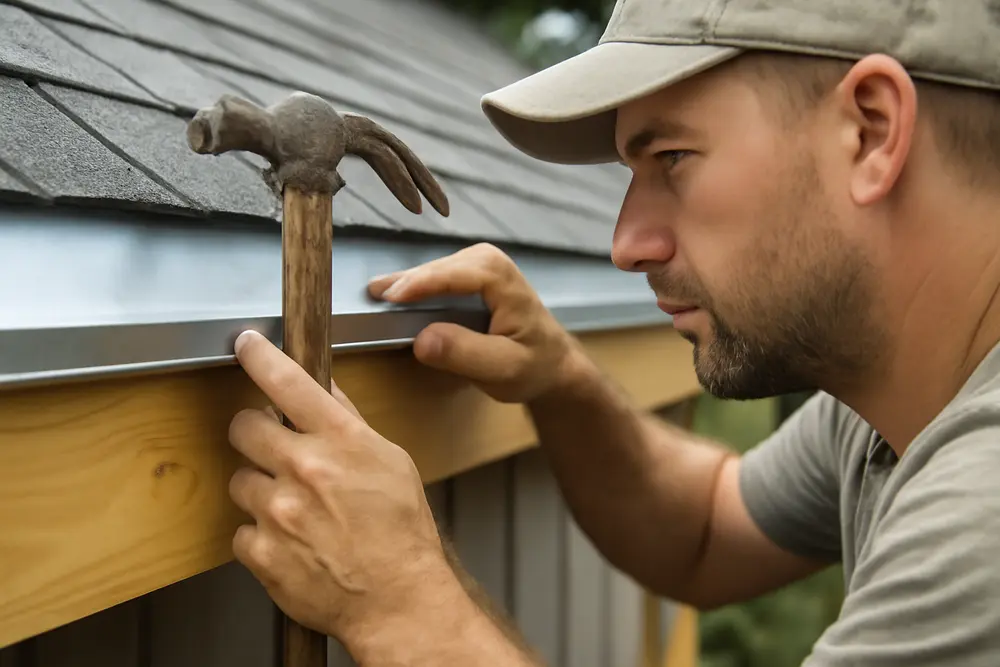
If you have gutters that sag, soffits that stain, or fascia boards that feel like a damp sponge, your roof is probably missing one tiny piece of metal that does an outsized amount of work. It’s called drip edge, and older Austin roofs often skipped it. The result is wind-driven rain sneaking behind your shingles and chewing on your woodwork like a beaver with a grudge. The fix is simple, fast, and way cheaper than replacing rotten fascia and soggy attic insulation: a roof drip edge retrofit. Here’s how this small upgrade knocks out leaks and stops fascia rot before it starts.
What A Drip Edge Actually Does
Drip edge is a thin L-shaped or T-shaped strip of metal that runs along your eaves and rake edges. Its job is to kick water away from the roof deck and fascia so water can’t curl back under shingles or sneak behind gutters. On a stormy Austin afternoon when rain is blasting sideways, drip edge is the bouncer at the door, keeping water pointed down and out where it belongs.
Without drip edge, water follows surfaces by capillary action and wind pressure. It rides uphill under the shingle edge, runs behind the gutter, and soaks the top of your fascia board. Do that a few dozen times each storm season and you end up with swelling, paint failure, wood rot, loose gutters, and occasionally a stained ceiling that makes your living room look like a Rorschach test.
Why So Many Austin Roofs Miss It
Plenty of Austin homes were built before current roofing codes made drip edge a must-have on asphalt shingle roofs. Back then, it was common to skip it. Fast builds in boom years also cut corners on details that were not strictly required. Even some roof replacements from the early 2000s to mid-2010s left drip edge off to shave time and materials. If your house predates modern code updates or you have a past reroof that did not include metal at the edges, your roof edge is probably unprotected.
Today, the International Residential Code, as adopted by many Texas municipalities including Austin, calls for drip edge on new shingle roofs. That solves the problem for new builds, but it does not help the thousands of existing homes that still need protection. That is where a roof drip edge retrofit comes in.
The Ugly Domino Effect Without It
When you leave the roof edge exposed, wind-driven rain and splash-back behind gutters set off a cascading mess. First, the fascia board starts to swell and bow. Paint blisters. Nails rust. Gutters no longer hold plumb and water overflows in the wrong spots. Next, moisture creeps under the shingles, softening the roof deck at the edge. The first row of shingles begins to curl because it is constantly damp and sun-baked. Finally, the attic at the perimeter sees intermittent wetting, which can stain the top of exterior walls, mat down insulation, and kickstart mold.
From a restoration standpoint, this is the greatest hits album we never wanted. We get called for “mystery leaks” in storms that never show up on sunny days. We pull back the soffit and find blackened, crumbly fascia and a water track running along the lower edge of the sheathing. Homeowners are shocked that all this fun started with a missing 1-inch lip of metal. That is the power of drip edge, and the cost of living without it.
Signs You Need A Drip Edge Retrofit
You do not have to climb onto your roof to spot a problem. Start with a slow lap around the house after a storm, then check the attic edge from inside.
| Sign | What It Tells You |
|---|---|
| Soft or swollen fascia boards | Water is getting behind the gutter or under the shingle edge and soaking the wood. |
| Visible gap at the roof edge | You can see daylight between the roof deck and fascia, which invites wind-blown water. |
| Water stains on soffits or exterior walls | Water is tracking behind the gutter or through the eave, not off the edge. |
| Gutters pulling away or repeatedly clogging at corners | Rot has weakened fasteners, or water is bypassing the gutter entirely. |
| Shingles curling at the lower edge | Chronic wetting at the eave is breaking down the shingle and underlayment. |
| No metal visible at edges | There is likely no drip edge, which leaves the roof edge exposed to storms. |
How A Roof Drip Edge Retrofit Works
A retrofit is the surgical way to add drip edge to a roof that never had it, without tearing the whole roof off. It is less invasive than it sounds, and when done right it looks like it has been there since day one.
Correct Placement At Eaves
Along the eaves, drip edge belongs over the underlayment so runoff that reaches the felt or synthetic layer flows onto the metal and into the gutter. The outer lip of the metal should project into or just above the gutter, not behind it. Sections are overlapped, seams are aligned with the slope, and fasteners are spaced consistently so the metal lays flat and does not oil-can. Done properly, the wood at the roof edge is fully covered, which keeps capillary action from tugging water back toward the fascia.
Correct Placement At Rakes
Along the rakes, the drip edge tucks under the underlayment, then the shingles overlap the metal. This gives wind-lift resistance, keeps the shingle edge from cracking, and closes off a sneaky entry point for wind-driven rain. Every piece is installed with the same directional overlap so water cannot catch a seam and push inward.
Materials That Last
Most Austin homes do well with prefinished aluminum or galvanized steel drip edge. Steel is robust around ladders and gutter cleaning. Aluminum’s factory finish pairs well with aluminum gutters. Coastal or industrial areas sometimes benefit from coated steel or even copper. The key is a code-approved profile with a proper kick-out edge, corrosion resistance matched to your gutter and fastener metals, and a color that does not broadcast “new patch” from the street.
What It Costs And What It Saves
There are plenty of variables, like total linear feet, slope, roof height, gutter removal and reset, and whether there is existing rot to replace. Still, a roof drip edge retrofit is typically a modest line item compared to the heavy hitters we see in restoration. Rebuilding long runs of fascia and soffit, reframing rotted rafter tails, replacing water-damaged sheathing, repainting, reinsulating, and cleaning up minor attic mold can stack into thousands. The drip edge itself is inexpensive, the labor is straightforward, and the return on stopping moisture at the source is hard to beat.
Think of it as flood insurance for your roof edge. It is not flashy, but it turns recurring edge wetting into dry, predictable drainage. That is real fascia rot prevention, and it keeps the rest of your roof system from aging in dog years.
DIY Or Call A Pro?
Some handy homeowners can handle sections on a shed roof or low single-story eaves. That said, most retrofits are done cleaner and faster by a crew that lives on ladders and knows how to work around gutters, starter shingles, and underlayment without causing new leaks. You also want correct sequencing at eaves versus rakes, proper overlaps, and fasteners that do not create corrosion conflicts with your gutters.
If your home is two stories, has steep slopes, brittle shingles, or active leaks, call a pro. Professional installers can also spot companion problems like inadequate starter strips, missing kick-out flashing at wall intersections, or gutter pitch issues. If you are hoping for manufacturer warranty coverage on your shingles, having the edges detailed to current standards is usually part of the conversation.
Gutters Alone Are Not Enough
We hear this a lot: “I have big gutters, so I do not need drip edge.” Gutters move collected water once it leaves the roof edge. They do not control what water does in the last inch of the roof system. Without drip edge, water regularly curls behind even perfectly hung gutters, then chews on fascia from the backside. If you like your gutters, protect the wood that holds them up. Drip edge and gutters are teammates, not substitutes.
Austin Code And Storm Reality
Austin’s adoption of modern roofing code makes drip edge standard on new shingle roofs because it is proven to stop edge leaks and slow shingle deterioration. Our weather makes it twice as smart. Central Texas storms often bring high winds that push rain under anything that is not mechanically controlled. Microbursts and hail events tend to be messy, and that horizontal rain finds the weak spots. Drip edge closes one of the most common gaps on older homes and dramatically reduces storm-driven intrusion at the eaves and rakes.
Case Study: 1978 North Austin Ranch
We were called to a one-story ranch that looked fine from the curb. The homeowner reported soffit staining above the porch and a gutter that would not stay tight at the corner. Up the ladder, we found zero metal at the eaves, curled starter shingles, and fascia that a screwdriver could sink into. Inside the attic, the first 8 inches of roof deck were discolored along 30 feet of the front eave, with light insulation staining.
Scope: we replaced 16 feet of rotted fascia, reset and repitched the corner gutter, slipped new starter under the first shingle course where it was shot, and installed color-matched steel drip edge along the entire front eave. We tied the eave metal over the underlayment, tucked the rake metal under, overlapped joints with the flow, and sealed the gutter spikes back into solid wood. The next sideways rain came through two days later. No more soffit stains, no gutter drip line, and the attic edge dried out and stayed that way. The fix cost far less than replacing the soffit and repainting the entire front elevation, which is where the house was headed.
What A Clean Retrofit Looks Like
You should see a straight, uniform metal edge with a crisp kick-out lip, no waviness, and no exposed raw wood. The drip edge should not shove the first shingle up like a ski jump. At the gutter, water should hit the trough instead of the fascia, and you should not see water racing behind the gutter during heavy rain. From the attic, the underside of the sheathing near the eave should be dry after storms, not blotchy or damp. You are aiming for boring, silent performance every time it rains.
Common Mistakes To Avoid
Even a simple detail can be botched if you rush it. The worst offenders we see are installing eave metal under the underlayment, missing overlaps at joints, using incompatible fasteners that corrode, and shoving the metal behind the gutter so water still runs behind the trough. Another big miss is skipping damaged fascia replacement before installing new metal. Drip edge needs solid, straight backing to sit flat. If rot is present, replace the wood first, then set your metal.
Will Drip Edge Help With Pests?
Yes, indirectly. Birds and rodents love lounging at open rake edges where the underlayment is curled or chewed back. A proper rake drip edge closes that gap and makes the edge too tight to nest in. It also makes your shingle edges far less inviting to lift and pry. You are not building Fort Knox, but you are not laying out a welcome mat either.
What To Expect During Installation
A typical roof drip edge retrofit on a single-story home can be completed in a day or two, depending on total footage and whether gutters need to be temporarily loosened and reset. You may hear some light hammering as the crew fastens the metal. If any fascia or soffit replacement is needed, that adds time. When done, expect a tidy site with no metal shards in the driveway and a roof edge that looks neat and original to the home.
Maintenance After The Retrofit
There is not much to do besides normal gutter cleaning and annual roof checks. Peek at the edges after the first big storm. Confirm water is tracking into the gutters, not behind them. Keep trees trimmed a few feet off the roof edge so branches do not scrape the metal or knock shingles out of line. If you get a hail hit or major wind event, ask for a quick inspection to be sure everything is still tight.
FAQ
Can you add drip edge without replacing the whole roof?
Yes. That is exactly what a roof drip edge retrofit is. Crews usually lift or loosen the first shingle course, set the metal correctly relative to the underlayment, fasten, and reseal as needed. The rest of the roof stays in place.
What metal is best for Austin homes?
Pafinished aluminum and galvanized steel are the most common. Match metals with your gutters and fasteners to avoid galvanic corrosion. If you have copper gutters, use copper drip edge or an appropriate separator.
Will drip edge fix an existing attic leak?
If the leak source is wind-driven water at the edges, yes, drip edge often stops it. If your leak is from a vent, valley, chimney, or worn shingles, you will need those repaired too. An inspection will sort that out.
Do gutters still need a gutter apron?
Some gutter systems use a dedicated gutter apron that pairs with drip edge to bridge the gap over the back of the gutter. They do different jobs. Drip edge manages the roof edge. Gutter apron mates the roof edge to the gutter. Many installs use both.
How long does drip edge last?
Quality metal paired with the right fasteners should match or outlast your current shingle cycle. If you do a full reroof later, your installer can reuse or replace the drip edge depending on condition and color choice.
Will this help with fascia rot prevention?
Absolutely. By keeping water from curling behind the gutter and onto the wood, drip edge removes the main trigger for fascia rot. Pair it with sound paint, caulk, and correct gutter pitch for long-term results.
Ready For Fascia Rot Prevention?
If your roof edge has gone bare-metal-free for years, there is a good chance it has been quietly taking on water in every storm. A quick inspection will tell you if you need a roof drip edge retrofit, fascia repair, or both. We retrofit drip edge on older Austin roofs every week, and we do it with the same attention we bring to water damage and mold work, because the best restoration job is the one you never need. Book an inspection, get the edge detailed right, and let the next sideways rain be someone else’s problem.