
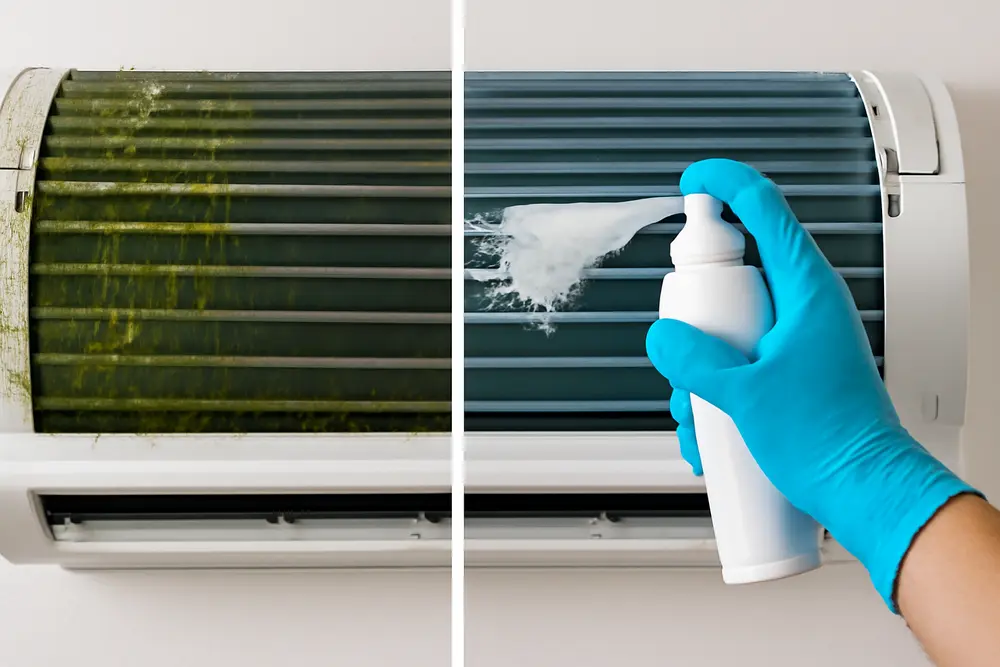
If your ductless head smells like a gym sock and sounds like it’s gargling oatmeal, you’re not crazy. You’re hosting a thriving biofilm party inside that mini-split. In Austin and other humid-friendly zones, these little wall-hung workhorses sweat constantly. That wet-and-dark combo is paradise for fungi and bacteria that glue themselves together into a slimy layer that laughs at quick wipes. This guide shows you how pros approach ductless mini-split cleaning from safe teardown to biofilm decontamination to long-term prevention that actually sticks. We’ll cover containment so you don’t aerosolize gunk into your living room, the chemistries that work on stubborn EPS slime, and how to tune humidity and filtration so your unit stops growing its own ecosystem.
Why Mini-Splits Grow Biofilm
Biofilm is a sticky matrix that microbes produce to protect themselves. It’s not just dust with a bad attitude. It’s a living shield called extracellular polymeric substance that lets microbes cling to coil fins, blower wheels, and drain pans while resisting half-hearted cleanings. On a ductless indoor head, the evaporator coil stays wet whenever the unit cools. The blower wheel throws that moisture around the cabinet. The drain pan and line collect condensate and any stray nutrients in the air. You’ve basically built the perfect terrarium for biofilm. Over time, that slime reduces airflow, chokes heat transfer, stokes odors, and even sends fragments and spores back into your room.
Industry sources have said the wet and shaded coil face and drain pan are biofilm central, and they’re right. If you only wipe the front grille or rinse the filter, you’re ignoring the heart of the problem. True ductless mini-split cleaning gets to the coil, blower wheel, and pan where the biofilm actually lives.
Clues Your Mini-Split Is Colonized
You don’t need a microscope to spot trouble. If you notice a musty dirty-sock odor when the unit first kicks on, reduced airflow even with clean filters, random drips or splatter from the head, visible slime or speckling on the vanes or coil, or a dusty black film on the blower wheel blades, you’ve got growth. Some units will whistle or vibrate because the blower wheel is out of balance from built-up gunk. Energy bills quietly creep up too because biofilm insulates those coil fins like a fuzzy sweater.
Safety And Prep That Saves Your Bacon
Start with the breaker. Don’t trust the remote. Kill power at the panel that feeds the indoor head so you’re not surprised by a self-test or fan spin. Protect yourself with gloves, eye protection, and a quality mask or respirator if you’re sensitive. Slipcovers and drop cloths are smart, but a proper mini-split cleaning bag that funnels runoff into a bucket is smarter. Stage a HEPA air scrubber in the room if you have one, because cleaning throws aerosols. If you’re in a tight space or a bedroom, set up a light containment barrier so you’re not sharing bio-aerosols with the rest of the house.
Round up tools that won’t wreck delicate parts. Soft brushes, a fin comb for bent fins, a vacuum with a brush attachment, microfiber cloths, a low-pressure pump sprayer for rinse, and non-acidic coil cleaner or enzyme cleaner. Keep a screw tray handy and snap photos as you go. You’ll thank yourself when it’s time to reassemble those louvers and sensors.
Smart Teardown For Deep Cleaning
Open the front cover by releasing side clips or screws. On many models the whole fascia tilts then lifts off locating pins. Pull the washable pre-filters and start them soaking in a neutral cleaner. With the cover off, you’ll see the evaporator coil face and blower wheel. Work gently around thermistor wires and control boards. If the louver assembly blocks removal of the blower wheel, note the small linkage and motor connectors before you separate them.
The goal is full exposure of the coil face and the entire circumference of the blower wheel. If you can’t slide out the wheel on your model without major disassembly, you can still clean it in place with targeted spray and careful brushing while the cleaning bag catches runoff. Brush from back to front on coil fins to lift slime without bending them. A fin comb helps correct any dings you create. Avoid blasting electronics and control boards. If you see standing water or sludge in the pan, clear the drain line before you start heavy rinsing so you’re not flooding the cabinet.
How Do You Control Aerosols While Cleaning?
Deep cleaning flings tiny droplets, biofilm fragments, and cleaner mist. You don’t want that drifting into the nursery. Wrap the indoor head in a fitted mini-split cleaning bag with a drain spout and place a bucket underneath. Shut doors to the room and run a HEPA air scrubber or negative air machine to pull air away from your face and through HEPA filtration. Keep your sprayer set to low pressure so you’re rinsing, not sandblasting. If someone in the home is immunocompromised or highly reactive, pause work and upgrade to a full containment setup with zipper entry and dedicated negative pressure until the job is done. This is standard practice in professional HVAC and IAQ cleaning during high-risk tasks, and it keeps the mess where it belongs.
Chemistries That Actually Break Biofilm
Here’s where most DIY efforts fall apart. Biofilm isn’t just sitting there waiting for a quick bleach spritz. You need a cleaner that either dissolves the EPS matrix or lifts it off the surface so you can rinse it away. Then you can apply a registered biocide or leave behind a preventive measure like UV-C. Start with cleaning, then consider disinfection. Doing it backwards wastes product and leaves slime intact.
Neutral or mildly alkaline foaming coil cleaners are safe on aluminum and copper. They push into the fins and lift organic grime without etching. Bio-enzymatic cleaners can be excellent on organic slime because they target the gluey matrix and keep working in crevices. Oxidizers like stabilized hydrogen peroxide can be effective when used at manufacturer-recommended concentrations for coils. Go too strong and you may discolor aluminum or chalk plastics. Acid coil cleaners are powerful on mineral scale but risky for modern fins and coatings, so they’re rarely the right choice for indoor heads.
Biocides have their place after cleaning and after you verify things are drying correctly. Apply them to clean, wettable, non-porous surfaces per the label and keep in mind that air movement can drift droplets. If you use quats or similar disinfectants, rinse if the label requires it before the unit runs, and keep overspray off electronics. Never mix chemicals. Bleach and ammonia is not a cool science experiment. When in doubt, pick a single chemistry system and follow the label like it’s the only map out of the woods.
If you want continuous prevention, UV-C installed near the coil and drain pan keeps new growth in check by disrupting microbe DNA as air recirculates. Properly installed UV-GI systems aimed at the coil face are well documented for reducing slime on the wet side of HVAC equipment. Choose equipment designed for tight mini-split cabinets and shield plastics that are sensitive to UV exposure.
For deeper reading, you can check out guidance on coil cleaning methods from manufacturers and IAQ specialists, like the cleaning approach in GREE’s service tips and UV-C application notes from BioShieldUV.
Cleaner Types Compared
| Cleaner Type | Where It Shines | Watch Outs |
|---|---|---|
| Neutral or mild-alkaline foaming coil cleaner | General organic buildup on fins and pans | Follow dwell time, avoid overspray on boards |
| Bio-enzymatic cleaner | Breaking EPS slime on coils and blower wheels | Needs time to work, not a wipe-and-go |
| Stabilized hydrogen peroxide | Oxidizes residues after bulk soil removal | Too strong can pit aluminum or fade plastics |
| Quat-based disinfectant | Post-clean disinfection on non-porous surfaces | Respect labels, possible rinse needed |
| Acid coil cleaner | Mineral scale on outdoor coils | Often too harsh for indoor coils and coatings |
Rinse Like A Pro And Dry It Out
Once your cleaner has done its job, rinse with low pressure and patience. Work top to bottom and back to front so you’re moving soil toward the drain bag spout. Rotate the blower wheel by hand to expose all blades as you rinse. Keep electronics dry by shielding boards and connectors with plastic sheeting or zip bags. If your model has a coil temperature sensor clipped to the fins, avoid blasting it and make sure it’s re-seated in the same location later.
After rinsing, empty the drain pan and verify the line is flowing. A quick way is to pour a cup of clean water into the pan and watch it leave through the condensate outlet. If it backs up, vacuum the line from the far end outdoors or use a dedicated condensate line cleaner until it runs clear. The drain line should have steady downhill slope and no sags that hold water. Standing water equals instant biofilm recharge.
Drying matters more than most people realize. If you trap moisture behind panels or reinstall filters while still wet, you’re seeding the next bloom. Towel-dry accessible surfaces, then run the fan-only mode with the cabinet open for 30 to 60 minutes, or use a dehumidifier and a HEPA air scrubber in the room to speed things up. Many mini-splits have a coil-dry or mildew-proof cycle. Use it. Just make sure power is restored safely before any run-dry sequence.
Reassembly Without Regrets
Before you button up, double-check every connector you touched. Reinstall the blower wheel straight so it doesn’t wobble. Make sure louvers move freely and the linkage is snapped back in. Filters must be fully dry. Inspect the front panel foam seals and gaskets. Torn or missing seals can create condensation in the wrong places and drip. Once reassembled, restore power and test cooling. Listen for new rattles. If the coil ices up within minutes, you’ve got an airflow or refrigerant issue that cleaning won’t fix, which is time to call an HVAC technician.
Humidity And Filtration That Stop Regrowth
You can clean like a champ and still lose the war if your indoor humidity stays high. Keep RH in the sweet spot between 30 and 50 percent. Run the mini-split’s dry or dehumidify mode during sticky stretches. Use a stand-alone dehumidifier if your home tends to hold moisture or if the space is oversized for the mini-split. We’ve written about how high humidity drives water damage and mold in our city and those same principles put mini-splits at risk. Aim for steady control, not roller-coaster spikes.
Filtration is the other half. Ductless heads usually ship with washable mesh pre-filters that only catch the big stuff. If your model supports upgraded media inserts or PM filters, use them. Replace or wash them per the manufacturer schedule, typically monthly in heavy use. In homes with pets, open windows, or a lot of cooking, add a room HEPA purifier staged where the mini-split draws air across the room. Catch particles before they decorate your coil. In central systems we like MERV 11 to 13 when the fan and coil can handle it. For ductless units, the safe play is frequent filter cleaning and supplemental room filtration.
UV-C, Drain Lines, And Smart Upgrades
Once the system is clean, stack the deck. A UV-C stick designed for mini-splits mounted to shine at the coil face and drain pan helps suppress new growth between cleanings. Choose gear made for tight indoor heads and rated for plastics like louvers and wire insulation. Replace UV lamps per the manufacturer cycle because output drops long before they burn out.
Keep the drain line trustworthy with periodic vacuuming from the outlet and with pan treatments that are compatible with your materials. Avoid anything perfumed that can coat the coil. Confirm your line has a continuous slope to daylight or a pump that’s not gummed up. If you use a condensate pump, clean or replace it before it surprises you with a mid-July flood on your wall.
DIY Or Call A Pro?
If you’re mechanically inclined and the growth is mild, you can handle a careful cleaning with a proper bag, safe chemistries, and patience. Stick to non-acid coil cleaners or enzyme cleaners, rinse thoroughly, and control aerosols. That said, if the blower wheel is tar-black, the odor makes your eyes water, the home has health-sensitive occupants, or you see biofilm beyond the head like in the line set cover or wall cavity, call a restoration company that understands containment and biofilm decontamination.
Professional deep cleaning usually includes disassembly to access the wheel and pan, HEPA-filtered negative air in the work zone, application of cleaners that break EPS slime, targeted disinfection per label after cleaning, drain line service, fin straightening, and functional checks. Expect tiered pricing by accessibility and severity. In our market, per-head deep clean pricing often lands in the low hundreds, with UV-C installs and pump service as add-ons. If someone quotes a bargain-basement spray-and-pray, that’s not the service you want.
Step-By-Step Mini-Split Deep Clean
You asked for real steps, so here’s the lean version used by pros for ductless mini-split cleaning. Adjust for your exact model and always follow the manufacturer manual.
1. Kill power at the breaker. Protect floors and set a cleaning bag on the head with a drain to a bucket. Stage PPE and a HEPA scrubber if available.
2. Remove the fascia and filters. Pre-clean filters and set to dry.
3. Photograph sensor and connector locations. Remove louver assemblies if needed for access.
4. Brush loose debris from the coil and blower wheel. Vacuum with a brush tool to reduce runoff sludge.
5. Apply your chosen coil cleaner or enzyme to the coil and wheel. Allow proper dwell time.
6. Rinse low and slow into the bag. Rotate the wheel to reach all blades.
7. Clean the drain pan and confirm the condensate line is clear and sloped. Correct kinks or sagging.
8. Optional disinfectant on cleaned, non-porous surfaces if labels allow. Avoid electronics and rinse if required.
9. Dry with towels, then run fan-only with the cabinet open. Use dehumidification in the room to speed drying.
10. Reassemble, verify louver movement, restore power, and test cooling. Run a coil-dry cycle if available.
What Should You Ask A Contractor?
Not all cleanings are created equal. Ask how they control aerosols and protect occupants. Ask if they disassemble enough to access the entire blower wheel and pan, not just spray the front and run. Ask what cleaners they use and why. Ask if they verify drain line flow and slope. Ask whether they can add UV-C sized for mini-splits and if they provide before-and-after photos. If the answers are vague or they say it takes 20 minutes, you’re paying for a shine, not a solution.
FAQs
How often should a ductless head be deep cleaned?
In a humid climate, plan on twice a year. If you run 24/7 for cooling and heating, quarterly inspections and at least one deep clean per cooling season help. Filters should be checked monthly.
Can I use bleach on my mini-split?
We don’t recommend it. Bleach is corrosive, risky around metals and plastics, and unsafe around electronics. There are coil cleaners and enzyme products made for HVAC use that work better and rinse cleaner.
Do UV-C lamps replace cleaning?
No. UV-C helps prevent regrowth, but it doesn’t remove existing slime and dirt. Clean first, then use UV-C as insurance between services.
Why does the smell come back a week after I clean it?
If you only cleaned the front grill or sprayed a deodorizer, the biofilm on the wheel and coil is still intact. Odors will return fast. You also might have a wet drain pan, a clogged line, or high indoor humidity feeding the beast.
Is constant fan mode good or bad?
Constant fan can re-evaporate moisture off the coil and keep things damp. Many units have a post-cool purge or coil-dry mode that runs the fan briefly to dry the coil without keeping it wet all day. Auto with a coil-dry feature is a better strategy.
What about the outdoor unit?
Outdoor coils collect dust and pollen that cut performance, but they’re usually not a mold party. Rinse the outdoor coil with a hose on gentle spray and keep vegetation clear. Use coil-safe cleaners when needed and avoid bending fins.
Ready For help in Austin?
We handle the messy stuff every day and we do it with proper containment, HEPA filtration, and chemistries that actually break biofilm. If your mini-split smells funky, drips on the wall, or looks like it grew eyebrows, we can bring it back and set it up to stay clean. We can also help dial in humidity and tackle any condensate lines that are staging a rebellion. Tap us for real ductless mini-split cleaning and biofilm decontamination that sticks. We’ll show you the before-and-after, then show you how to keep it that way.