

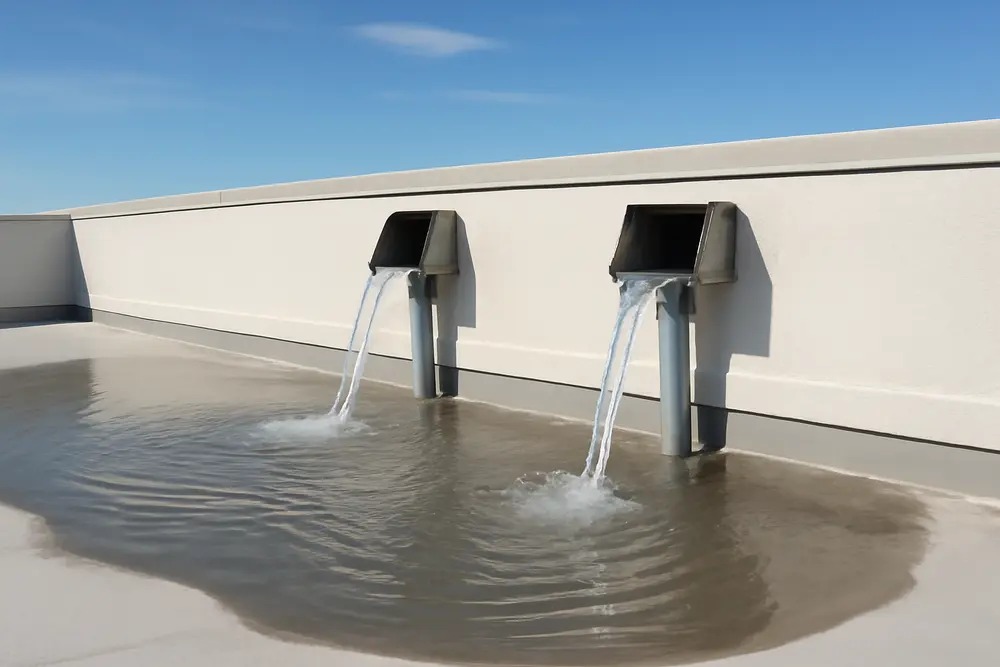
You bought a flat roof because it looked clean and modern. What you did not buy was a rooftop kiddie pool. If water is lingering for days, your flat roof is telling you something: your scuppers and drains need attention. This is a fast, no-fluff guide to flat roof scuppers, internal drains, and the simple roof drain maintenance that keeps ponding, leaks, and mold from moving in. I fix the mess when things go sideways, but I’d rather help you avoid it with a few smart checks and upgrades.
What Flat Roof Scuppers Actually Do
Flat roof scuppers are openings through the parapet wall that let water exit from the roof to the outside. They usually discharge to a conductor head and downspout or directly off the edge. Internal roof drains do the same job but route water through a bowl, strainer, and piping inside the building. Many buildings have both: primary drains at the low point and overflow scuppers a bit higher to act as a fail-safe if the main drains clog. All of it only works if water can find its way to the outlets. That means realistic slope, clean inlets, and flashing that does not let water sneak behind the membrane.
Ponding Water 101
Ponding is water that hangs around longer than about 48 hours after a storm or snow melt. That puddle does not just look bad. It heats the membrane under the sun, breaks down the surface, drives seams apart, and seeps into every weak detail. Insulation below loses performance when it stays wet, which means higher energy bills. Then there is the weight. Water is roughly 5 pounds per square foot for every inch of depth. Two inches of ponding over a 20-by-20 low spot is not a mood, it is a small truck sitting on your roof. Keep that up and the deck starts to deflect, which makes the low spot deeper, which traps more water. That is the doom loop we break with maintenance.
Signs Your Roof Is Begging For Help
If a storm ends on Monday and you still have standing water on Wednesday, you have a drainage problem. Look for coffee-brown rings in the pond area that mark the waterline. Silt lines around scuppers, algae halos, or wet footprints that never dry are all red flags. Membrane issues usually show up next: spongy or soft areas underfoot, blisters, cracks near seams, and peeling around parapet corners or scupper throats. Inside, water stains, sagging drywall, musty odors, or bubbling paint under window heads often trace back to failed roof details. Outside, streaks below the scupper, water blasting out of a downspout during normal rain, or drips through masonry joints below the parapet scream restricted flow. None of these are normal for a healthy flat roof.
Fast Roof Drain Maintenance That Works
Before you climb, respect the height. Use proper access, stable footing, and fall protection. Never step into a ponded area without checking the substrate. If the deck feels bouncy, get off the roof and call a pro.
Start with your easiest win: clear the inlets. Pull leaves, seed pods, roofing granules, and silt from around scuppers and drain bowls. If you have strainers, make sure they are attached and the right size. Domed or basket strainers keep junk out but only if they are not clogged themselves. Look down the scupper throat with a flashlight and clear any sticks or bird nests. On internal drains, check the clamping ring and make sure the membrane is seated and not torn. If the drain ties into a leader inside the building, listen for a hollow rush when you pour a bucket of water. A slow gurgle or backing up likely means the line is pinched or blocked.
Hose test the flow. Start at the furthest corner and run a gentle stream. Watch how water moves. If it stalls halfway, you probably have a low spot that needs tapered insulation or a cricket. If it comes roaring out of the scupper but sprays back on the wall, you need a conductor head or proper spout extension. If water at the primary drain climbs up and hits the overflow level, your main line is not keeping up.
Finish with a visual pass on details. Look at the scupper box or sleeve where it penetrates the parapet. Any gaps, curled membrane edges, exposed fasteners, or cracked sealant are leak invitations. Check the inside corners of parapet walls, the tops of pitch pockets, and transitions where the roof meets the wall. Fixing small splits now costs lunch money compared to interior repairs later.
Seasonal Maintenance You Can Actually Do
You do not need a facilities crew to keep a flat roof in shape. You do need a repeatable routine. Here is a clean way to schedule it.
| Frequency | What To Do |
|---|---|
| Quarterly & after storms | Clear debris at scuppers and drains, clean strainers, check that covers are secure and sized right, remove silt or gravel mounds that block flow. |
| Spring & fall | Inspect membrane and flashing, look for blisters, cracks, and gaps at parapet corners and scuppers, perform a hose test to watch slope. |
| Every 1-2 years | Call a roofer for a full inspection, review structural areas if you suspect deck deflection, consider moisture scanning if you have recurring leaks. |
Each season, bring a small bucket, a plastic scoop, and a trash bag. Lift the strainer, clear the bowl, and look inside the drain body. If you see rust jacking or loose hardware, flag it. At scuppers, make sure the metal sleeve is not deformed and that the membrane termination is tight. If your roof has ballast or pavers, check that nothing is stacked around the drain. Accessories like satellite mounts and HVAC stands love to wander and block flow. Keep a 3-foot no-parking zone around every drain and scupper.
Flashing Details That Leak
Most flat roof leaks do not start in the middle of the field. They start where two different materials meet and move differently with heat and cold. That is classic scupper territory. Water is racing for the exit and it only takes a small gap for it to sneak behind the sleeve. Look closely at the scupper throat where the roof membrane wraps into the opening. You want a clean, wrinkle-free termination and a solid seal at the edges. Parapet corners often split, especially where a cap lap meets the inside corner. The top of the wall needs a cap that sheds water outward with sealed joints. Inside the roof, any pipe, vent, or curb has flashing that relies on heat-welded seams or mastic. Caulk is not a structural fix. Use manufacturer-approved materials and let a roofer re-weld or replace failed flashing and scupper sleeves before they escalate into interior damage.
Smart Upgrades That Actually Work
If you are doing the cleaning but still battling puddles, you probably need an upgrade. These are the fixes that give you real return.
Tapered Insulation For Real Slope
Tapered insulation is the cheat code for flat roofs that do not drain. It adds built-in slope on top of the existing deck so water moves to drains and scuppers without heavy structural work. Common systems use polyiso panels cut in wedges to create 1/8 inch to 1/2 inch per foot of slope. Besides fixing ponding, you get better R-value and a drier roof assembly because water is not camping out. This is not a cheap patch, but it is the long-term answer when a deck has low spots or the original design skimped on slope. If you have large rooftop units, add crickets upstream to split the flow and shove water toward the nearest drain.
Overflow Scuppers As A Safety Valve
Overflow scuppers, sometimes called emergency scuppers, sit a bit higher on the parapet than your main drains or scuppers. If the primaries clog, the overflow gives water a second exit before it turns your roof into a bathtub. The gap between primary and overflow elevations needs to be set carefully so normal events do not hit the overflow, but big blockages do. Think of it as a backup parachute. If your building only has internal drains and no exterior escape, adding overflow scuppers can keep a clog from flooding the interior.
Strainers And Covers That Stay Put
Every drain needs a strainer and every scupper needs a guard that keeps sticks and leaves out without creating a choke point. Domed drain strainers are better than flat covers because they keep the intake area open as debris piles up. On scuppers, a welded cage or removable basket stops big debris from entering the throat. Spend the extra few dollars on sturdy, UV-resistant parts that bolt down so they do not blow away in the first storm and leave you exposed.
Flashing And Parapet Rehab
If your scupper sleeve is pitted, the parapet cap is loose, or the counterflashing has pulled away, fix that before it turns into hidden water behind the wall. New scupper inserts, reinforced corners, and fresh terminations at the throat will do more to stop leaks than any pail of roof goo. If you can push the membrane and feel water squish around, you are past sealant territory and into replacement of wet materials.
Structural Repairs When The Deck Sags
When a roof deck deflects, water finds the low spot and refuses to leave. If your hose test makes an instant puddle at the same place every time, address the structure. A contractor can stiffen or sister joists, replace rotten decking, or rebuild the slope. Skip this and even the best tapered insulation plan may fight a losing battle.
Roof Drain Maintenance Without The Myths
There are a few bad ideas that keep making the rounds. Do not pour chemical drain openers into roof drains. They are not designed for roof systems and can eat gaskets or flashings. Do not hack holes in strainers to increase flow. That only invites larger debris into a pipe you cannot easily access. Do not glue down makeshift screens over scuppers that you cannot remove for cleaning. You want a guard, but you want one you can service.
DIY Or Call A Pro?
Homeowners and building managers can absolutely handle visual checks, clearing debris, replacing strainers, and testing flow with a hose. If water sits more than 48 hours after normal rain, if you find blisters or soft spots, or if any part of the deck feels bouncy, it is time to bring in a roofer. Call faster if you see water stains inside or active drips. If leaks soaked insulation or ceilings, that is where my team jumps in to dry, remediate, and put things back together. Infrared or moisture scanning is smart when you suspect trapped water under the membrane. That scan guides targeted repairs instead of guessing.
Winter And Storm Tips
Wind is a debris delivery system. After any big blow, check your scuppers, strainers, and the entire roof field for new junk. In winter, ice can form a dam across scuppers and bowls. Do not use sharp tools on membranes. Use safe de-icing products recommended for your roof type and open a path for meltwater. If snow loading is heavy, make sure your overflow scuppers are clear so one clogged primary does not turn into a roof lake. Heat cables at scuppers can help in problem zones, but they must be installed to manufacturer specs, tied to GFCI protection, and kept clear of combustible materials. A sloppy install solves one problem and creates three more.
What To Watch On The Ground
You do not need to be on the roof to spot roof drain trouble. If you see dirty waterfall stripes on the wall below a scupper, the outlet is sending water everywhere but the downspout. If downspouts cough mud at the first rain, your roof is shedding silt that came from ponding. If overflow scuppers discharge during average storms, your primaries are not keeping up. Ground clues are often what tip off interior leaks before they show up on drywall.
Small Fixes With Big Payoffs
Two things most roofs are missing: simple splash extensions at scuppers and cleanouts at the first elbow of internal drain lines. A 6 to 12 inch scupper extension or conductor head directs water into the downspout instead of along the wall. A cleanout makes maintenance real instead of a wrestling match. Both are low-cost upgrades that reduce water against your building skin and make service easier in every season.
Flat Roof Scuppers Vs Internal Drains
Scuppers are easier to understand and maintain because everything is visible, but they put water on the building exterior. That can be a problem if your facade is porous or your downspouts clog at ground level. Internal drains keep water inside a controlled pipe, which is great until that pipe plugs 30 feet inside a wall behind a tenant’s kitchen. That is why redundancy is not optional. A smart setup uses primary drains at low points, overflow scuppers to relieve blockages, and strainers and guards that keep the system from swallowing large debris in the first place. And all of it relies on slope. Without slope, you are in the pond business.
FAQ: Quick Answers To Real Questions
How often should I clean flat roof scuppers and drains?
Quarterly is a good baseline, with extra checks after heavy wind or leaf drops. If your property sits under trees or you had construction nearby, step it up during those seasons.
How long can water sit before I should worry?
If water is still there 48 hours after a normal event, you have a drainage or slope issue. Address it before the next storm makes it worse.
How deep is too deep for ponding?
Any persistent depth is bad news. Keep in mind that every inch adds roughly 5 pounds per square foot. Two or three inches over a big area can overload parts of a roof, especially older decks.
Can I snake a roof drain like a sink?
You can, but use a professional who knows roof drains and does not shred gaskets or flashing. Many roof drain blockages are at the first elbow. A cleanout fitting helps a lot.
Should I add gutter guards to scuppers?
Use purpose-built scupper guards or baskets, not generic gutter foam or screens that trap small debris and freeze solid in winter. Guards should be removable for cleaning and secured so they do not blow away.
Do green roofs change the drainage plan?
Yes. They need more rigorous pre-filtering and strainers to keep growing media out of drains. Maintenance frequency is higher, and overflow scuppers are even more valuable on vegetated systems.
Can I fix minor flashing gaps with caulk?
Caulk is a bandage, not a rebuild. It might buy you time, but proper repairs use compatible membrane materials, primers, and heat-welded or manufacturer-approved seams. Get a roofer to do it right.
Roof Drain Maintenance You Can Schedule Today
Block one hour on a calm day. Bring a trash bag, scoop, and hose. Clear each scupper and drain, verify strainers are installed, and run water from the high side across the roof. Watch the flow, mark any slow spots with chalk, and photograph problem areas so you can compare season to season. If water lingers, if the deck flexes, or if you spot damaged flashing, it is time for a roofing inspection. If you already have interior staining, swollen baseboards, or musty drywall, my crew can open, dry, and repair before mold takes the wheel.
Want A Pro To Triage It?
If your flat roof stands between Texas storms and a dry living room, give it the same respect you give your brakes. We handle the messy part when leaks turn into interior damage, but we are big fans of prevention. If you want us to check your flat roof scuppers, set up roof drain maintenance, add strainers, or map out tapered insulation and overflow scuppers, we are ready. We will walk the roof with you, show you what is working, and fix what is not, with before-and-after photos so the story is clear. No rooftop pools, no recurring mysteries, just a roof that drains like it should.