
Lithium-ion battery fires don’t end when the flames disappear. During thermal runaway, damaged cells can release intense heat, flammable gases, fine particles, toxic soot, and corrosive compounds such as hydrogen fluoride. Cells that still contain electrical energy may also heat up and reignite after the initial fire. Safe recovery requires much more than wiping black residue off the walls. The battery must be stabilized, electrical hazards controlled, contamination evaluated, and affected materials cleaned under a site-specific restoration plan.
Do not clean up a lithium-ion battery fire yourself. Leave immediately if a battery is hot, swollen, smoking, hissing, popping, venting, or producing a sharp or unusual odor. Call 911 from a safe location. Don’t touch, move, puncture, recharge, or place the damaged battery in household trash.
What Thermal Runaway Actually Does
Thermal runaway is a self-heating failure inside a battery cell. It begins when the cell produces heat faster than that heat can escape. An internal short circuit, overcharging, impact damage, excessive external heat, manufacturing defects, corrosion, or a failed charging system can start the process.
As the temperature rises, the thin separator between internal battery components may shrink, melt, or tear. That failure can create additional short circuits. Chemical reactions inside the cell then generate even more heat and release flammable gases. The reaction starts feeding itself, which is where the term thermal runaway comes from.
One small cell can also heat the cells beside it. In an e-bike pack containing dozens of cells, for example, the first cell may fail before the next row becomes hot enough to vent. This cell-to-cell propagation can continue inside a housing even when firefighters have knocked down the visible flames. In a larger electric vehicle or energy storage system, the pack may contain hundreds or thousands of individual cells arranged in modules.
The outer casing doesn’t offer a reliable view of what’s happening inside. A pack can look scorched but quiet while individual cells remain hot, energized, mechanically damaged, or chemically unstable. That uncertainty is one reason restoration crews shouldn’t treat the battery as another piece of burned debris.
Why Battery-Fire Residue Is Different
Ordinary building fires already produce a grim mixture of soot, melted plastics, char, and combustion byproducts. A lithium-ion battery adds electrolyte solvents, fluorinated salts, graphite, copper, aluminum, plastics, adhesives, separators, and cathode materials to the event. Depending on the chemistry, cathode particles may contain nickel, cobalt, manganese, iron, or other elements.
When those materials burn or thermally decompose, they can produce carbon monoxide, irritating organic vapors, acid gases, fine and ultrafine particles, fluorinated compounds, and metal-containing debris. Meanwhile, the shelf, charger, furniture, flooring, vehicle interior, or wall assembly surrounding the battery may contribute its own combustion products.
That black film on the windowsill isn’t chemically identified just because it looks like soot. Its composition depends on the battery chemistry, state of charge, temperature, oxygen supply, fire duration, enclosure, and suppression method. An e-bike battery fire in a closed apartment bedroom presents a different exposure situation from a phone battery burning on an outdoor concrete patio.
Odor isn’t a trustworthy test either. The lack of a harsh smell doesn’t prove that fine particulate or corrosive contamination is gone. Likewise, removing the visible black staining doesn’t establish that the surface is chemically clean. If a contractor’s entire clearance plan is a white rag and a sniff test, skepticism is warranted.
How Hydrogen Fluoride Changes the Job
Many lithium-ion batteries use fluorinated electrolyte salts, commonly including lithium hexafluorophosphate. Under fire conditions, these materials can decompose and generate hydrogen fluoride and other fluorinated compounds. Hydrogen fluoride, often shortened to HF, is primarily a corrosive gas. When it contacts water, it forms hydrofluoric acid.
This distinction matters. It isn’t accurate to claim that every speck of visible battery-fire soot contains hydrofluoric acid. HF can remain temporarily airborne, dissolve in firefighting water, interact with damp surfaces, or become associated with deposited particles. Fluoride-containing contamination may remain after the immediate gas hazard has decreased, but only incident-specific assessment can show where contamination traveled.
Peer-reviewed research on toxic fluoride emissions measured approximately 20 to 200 milligrams of hydrogen fluoride per watt-hour of battery capacity under the study’s test conditions. That’s a wide range, and it shouldn’t be plugged into a calculator to predict exposure inside a particular home. Real concentrations depend on the cell design, chemistry, ventilation, room volume, fire behavior, suppression, deposition, and time elapsed before testing.
Hydrogen fluoride can injure the eyes, skin, and respiratory tract. It can also penetrate tissue and interfere with calcium and magnesium in the body, potentially causing serious systemic effects. NIOSH hydrogen fluoride hazard data identifies 30 parts per million as immediately dangerous to life or health. That workplace reference isn’t a DIY reentry number or a target for homeowners armed with an inexpensive meter.
A standard four-gas meter typically checks oxygen, carbon monoxide, hydrogen sulfide, and combustible gas. It doesn’t automatically detect hydrogen fluoride. A photoionization detector shouldn’t be assumed to measure HF reliably either. Depending on the loss, an industrial hygienist or hazardous-materials specialist may use HF-specific equipment, detector tubes, air sampling, particulate sampling, surface wipes, or water and residue screening. No single meter checks for every possible battery-fire contaminant.
If anyone may have inhaled battery smoke or contacted suspicious residue or water, they should seek immediate medical guidance and tell medical personnel that a lithium-ion battery was involved. Delayed pain isn’t evidence that an exposure was harmless.
Why Batteries Reignite After the Fire
A damaged battery may retain stranded electrical energy even after the equipment is turned off. Disconnecting building power, operating a vehicle battery disconnect, or seeing a dead control screen doesn’t mean every cell is discharged. Individual cells may remain energized while the battery-management system is damaged or unable to communicate.
Cooling can slow internal reactions without repairing a torn separator, crushed electrode, or internal short. Heat may also migrate into a neighboring cell that hasn’t failed yet. If that cell later reaches its failure temperature, it can vent, ignite, or send the pack back into thermal runaway.
Movement adds another concern. Lifting a burned e-bike pack, loading an electric vehicle onto a tow truck, or shifting a stationary battery module may move damaged internal components. That movement can create a new short circuit. The NTSB investigation of lithium-ion battery fire risks addresses reignition, stranded energy, extended cooling, towing, and post-fire storage concerns involving electric vehicles.
A damaged lithium-ion battery can reignite hours later and, in documented circumstances, after it has been moved or stored. There isn’t a universal 24-hour or 48-hour rule that makes every pack safe. The right isolation and observation period depends on the battery design, damage, temperature trends, manufacturer guidance, and instructions from the authority having jurisdiction.
Thermal imaging is useful for watching temperature patterns, but a cool image isn’t a guarantee against lithium battery reignition. A camera measures surface temperature within its capabilities. It can’t certify the condition of every separator and internal cell.
Four Separate Phases of Recovery
Battery-fire recovery is easier to understand when it’s divided into separate jobs. Fire suppression controls immediate flames, heat, smoke, and life-safety threats. Battery stabilization addresses remaining electrical and thermal hazards. Hazardous-material removal manages the damaged pack, contaminated liquids, and regulated debris. Structural restoration cleans and repairs the building after those source hazards are controlled.
These phases often overlap, but they aren’t interchangeable. A restoration company doesn’t replace the fire department, an electrician, a battery manufacturer, an industrial hygienist, or a hazardous-material transportation provider. The restoration contractor may coordinate much of the property work while other qualified parties handle the pack itself.
For example, firefighters may extinguish an e-bike battery fire and release the apartment from emergency control. That doesn’t automatically authorize a cleaning crew to pick up the pack, carry it through the hallway, and put it in a dumpster. Qualified personnel may still need to evaluate cell temperatures, isolate electrical risks, select packaging, establish a storage plan, and arrange legal transportation.
How Professional Cleanup Works
Before cleanup begins, the team gathers as much information as possible about the battery. Useful details include the manufacturer, model, chemistry, capacity, state of charge, number of modules, safety data sheets, emergency response guide, suppression agents, duration of fire exposure, mechanical damage, and whether water entered the battery. The team also evaluates where smoke and firefighting water traveled.
Work zones may include an exclusion area around the damaged battery, a decontamination area, and a clean support area. HVAC equipment may need to remain off and isolated. When containment and negative air are appropriate, the equipment must be selected and positioned without introducing an ignition source into a potentially flammable atmosphere.
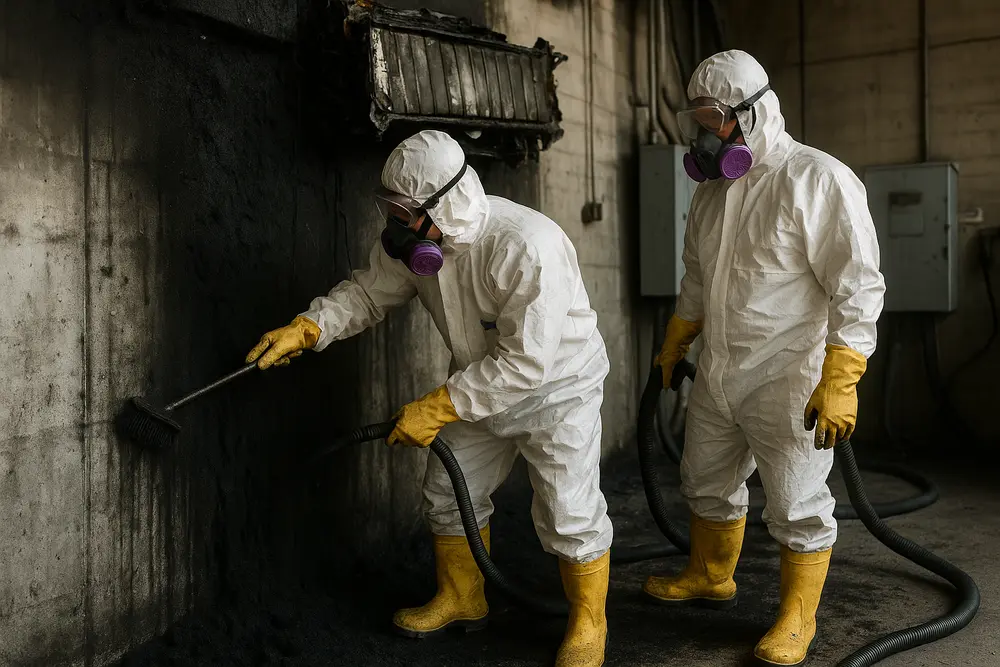
Personal protective equipment can’t be selected correctly from a generic internet checklist. The decision depends on whether the air has been characterized, along with oxygen levels, acid-gas concerns, organic vapors, particulate loading, splash exposure, heat, electrical hazards, and structural conditions. An unknown or immediately dangerous atmosphere may require positive-pressure self-contained breathing apparatus. Later cleaning may use a different respiratory protection level after a qualified assessment.
Once the atmosphere is addressed and the battery source is stabilized or removed, technicians can begin controlled residue removal. This may involve careful debris collection, suitable HEPA-filtered equipment, controlled wet wiping, repeated cleaning of nonporous materials, and removal of porous materials that can’t be decontaminated reliably. Disposable suits, wipes, filters, and debris are packaged without carrying contamination into clean areas.
Dry sweeping, compressed air, household vacuums, and uncontrolled fans can redistribute fine particles. Power washing may simply move contaminated water into wall cavities, soil, or storm drains. Ozone may affect odor, but it doesn’t pick metal-containing particles off a ceiling or remove fluoride contamination from wet debris. Painting over uncleaned residue is concealment, not toxic soot cleanup.
Cleaning products must fit both the contaminant and the material. A chemical that’s acceptable on sealed metal may damage stone, electronics, textiles, or finished wood. Home neutralization recipes aren’t an appropriate answer to suspected HF contamination. Guesswork is especially unattractive when corrosive chemistry and an energized battery are sharing the same room.
HVAC, Water, and Hidden Contamination
Battery fire smoke rarely respects the outline of the burn mark. Fine particles can travel through return-air pathways, supply ducts, open doors, utility penetrations, attics, wall cavities, and pressure differences created during the fire. If the HVAC system operated during the event, the air handler, filters, coils, plenums, registers, insulation, and accessible duct surfaces may require evaluation.
That doesn’t mean every duct system must be replaced. The correct scope depends on system design, residue distribution, material porosity, inspection findings, and sampling when it’s justified. Accessible metal ductwork may be cleanable, while contaminated porous insulation may not be. A blanket rule in either direction is usually a shortcut wearing a safety vest.
Suppression water deserves the same caution. It may contain dissolved fluoride compounds, metals, electrolyte decomposition products, suspended soot, ash, and whatever washed out of nearby burned materials. It shouldn’t automatically be pumped into a street, yard, storm drain, or ordinary sanitary drain. Waste characterization and disposal requirements vary by location, material, volume, and applicable regulations.
The battery itself also requires special handling. Federal rules include specific provisions for transporting damaged lithium batteries. Packaging and transportation requirements depend on the battery’s condition, size, transport method, and potential to produce dangerous heat, flame, or gas. A charred pack tossed into a contractor’s pickup isn’t a transportation plan.
How a Property Is Cleared for Use
Clearance shouldn’t rest on one normal meter reading, a cool thermal image, a better smell, or the passage of a fixed number of hours. Professionals look at several lines of evidence because each tool answers a different question.
The completion criteria may include documentation that the battery was removed, stabilized, or transferred to an appropriate party. Electrical hazards should be addressed by qualified personnel. The evaluation may also consider stable temperature trends, completed source removal, detailed cleaning, HVAC conditions, waste records, inspection under suitable lighting, and proof that containment didn’t spread residue into clean areas.
An industrial hygienist may recommend air or surface testing based on the battery, fire conditions, affected areas, and intended occupancy. The sampling method, detection limit, location, timing, and interpretation all matter. Testing only the cleanest-looking spot in the room provides a result, but it may not provide a useful answer.
Professional fire restoration standards such as the IICRC S700 fire and smoke restoration standard can support assessment, cleaning, documentation, and verification. They don’t replace electrical isolation, battery stabilization, hazardous-material evaluation, manufacturer instructions, or regulated transport.
What Property Owners Shouldn’t Do
Don’t pick up, open, cut, crush, puncture, recharge, or attempt to discharge a damaged battery. Don’t place it in water unless emergency specialists have developed an incident-specific plan. Water can be used strategically during some lithium-ion fire responses, but casually submerging an unstable pack creates new handling, electrical, and contaminated-water problems.
Don’t turn the HVAC system back on simply because the room has cooled. Don’t use a household vacuum on deposited soot. Don’t wash residue into the driveway or yard. Keep children and pets away from affected rooms, water, debris, and outdoor runoff.
A damaged pack doesn’t belong in household garbage, a standard dumpster, or curbside recycling. The EPA guidance for used lithium-ion batteries warns against putting lithium-ion batteries in household trash or municipal recycling bins. Fire-damaged batteries need an even more controlled evaluation and disposal process.
Don’t rely on odor-removal treatments as proof that the building is safe. Smelling better and being decontaminated aren’t the same thing. Battery fire restoration is source removal and contamination control first, followed by repair and odor treatment where appropriate.
When to Call Specialized Help
Any fire involving an e-bike, scooter, electric vehicle, power tool pack, home energy storage unit, or larger rechargeable battery deserves a cautious review. The larger the battery and the more enclosed the fire, the greater the potential need for coordinated fire, electrical, industrial hygiene, environmental, and restoration services.
A specialized restoration team can assess smoke migration, isolate affected areas, document damage, clean salvageable surfaces, evaluate porous materials, inspect HVAC exposure, and coordinate contaminated debris handling. Battery stabilization, de-energization, hazardous-material response, and transportation may require separate qualified contractors or public agencies.
For professional fire and smoke damage restoration in the Austin area, contact Austin Hi-Tech Restoration after emergency officials have controlled the scene. If the battery is hot, smoking, swollen, hissing, popping, venting, or showing renewed activity, leave the area and call 911 first.
Frequently Asked Questions
Can a Lithium-Ion Battery Reignite?
Yes. Cells can retain electrical energy, develop delayed internal short circuits, or transfer heat to adjacent cells. Reignition may occur after visible flames have been extinguished, including while the battery is being moved or stored.
Does a Battery Fire Produce Hydrogen Fluoride?
It can. Fluorinated electrolyte components may decompose during thermal runaway and release hydrogen fluoride and other fluorinated compounds. The amount and resulting exposure depend on battery chemistry, size, fire conditions, ventilation, suppression, and the affected space.
Is Hydrogen Fluoride Part of the Soot?
Hydrogen fluoride is primarily a gas and forms hydrofluoric acid when it contacts water. It may dissolve in firefighting water, interact with damp surfaces, or become associated with deposited particles. Visible soot may contain many other hazardous combustion products, but its appearance can’t identify HF.
Can I Vacuum Battery-Fire Soot?
Not with a household vacuum. Ordinary vacuums can redistribute fine particles and contaminate the machine. Appropriate HEPA-filtered equipment and controlled cleaning methods may be used after professionals address the battery, electrical, and atmospheric hazards.
How Long Does Reignition Risk Last?
There’s no universal time limit. Battery type, physical damage, state of charge, temperature trends, internal cell condition, manufacturer guidance, and storage arrangements all affect the risk. A fixed waiting period shouldn’t replace qualified evaluation.
Can a Damaged Battery Go in a Dumpster?
No. A fire-damaged lithium-ion battery needs specialized evaluation, packaging, transportation, and disposal. It shouldn’t enter household trash, a standard construction dumpster, or conventional recycling.
How Do Professionals Verify Safety?
They consider battery stabilization, electrical isolation, temperature trends, air conditions, completed residue removal, HVAC exposure, waste handling, and any incident-specific testing selected by an industrial hygienist. A clean appearance, lack of odor, or single meter reading isn’t enough by itself.